By the end of this chapter you will:
- Set up and scale ratios fluently
- Handle two-stage problems (before / after a change) by anchoring on the unchanged quantity
- Use for speed-time-distance, including the average-speed trap
- Solve coin / mixture problems with two simultaneous constraints
3.0 The BC gap
BC baseline: G6 introduces ratios (part-part, part-whole, equivalent) — but only the introductory mechanics. There is no two-stage manipulation, no formula, no average-speed problems, no mixture/coin word problems. G5 mentions duration / elapsed time but doesn't teach the base-60 carry/borrow that Gauss requires. This chapter fills all four gaps.
3.1 Ratio basics
A ratio is the same information as the fraction . Scaling preserves the ratio: .
Setup move: if quantities are in ratio , write them as and for some scaling factor .
Example
Two numbers are in ratio and sum to . Find the smaller.
Write them as and . Then . Smaller .
3.2 Two-stage ratio problems
The Gauss flavor: a ratio is given, an event changes one quantity, a new ratio is reported, and you must reconstruct.
Example — paradigm problem
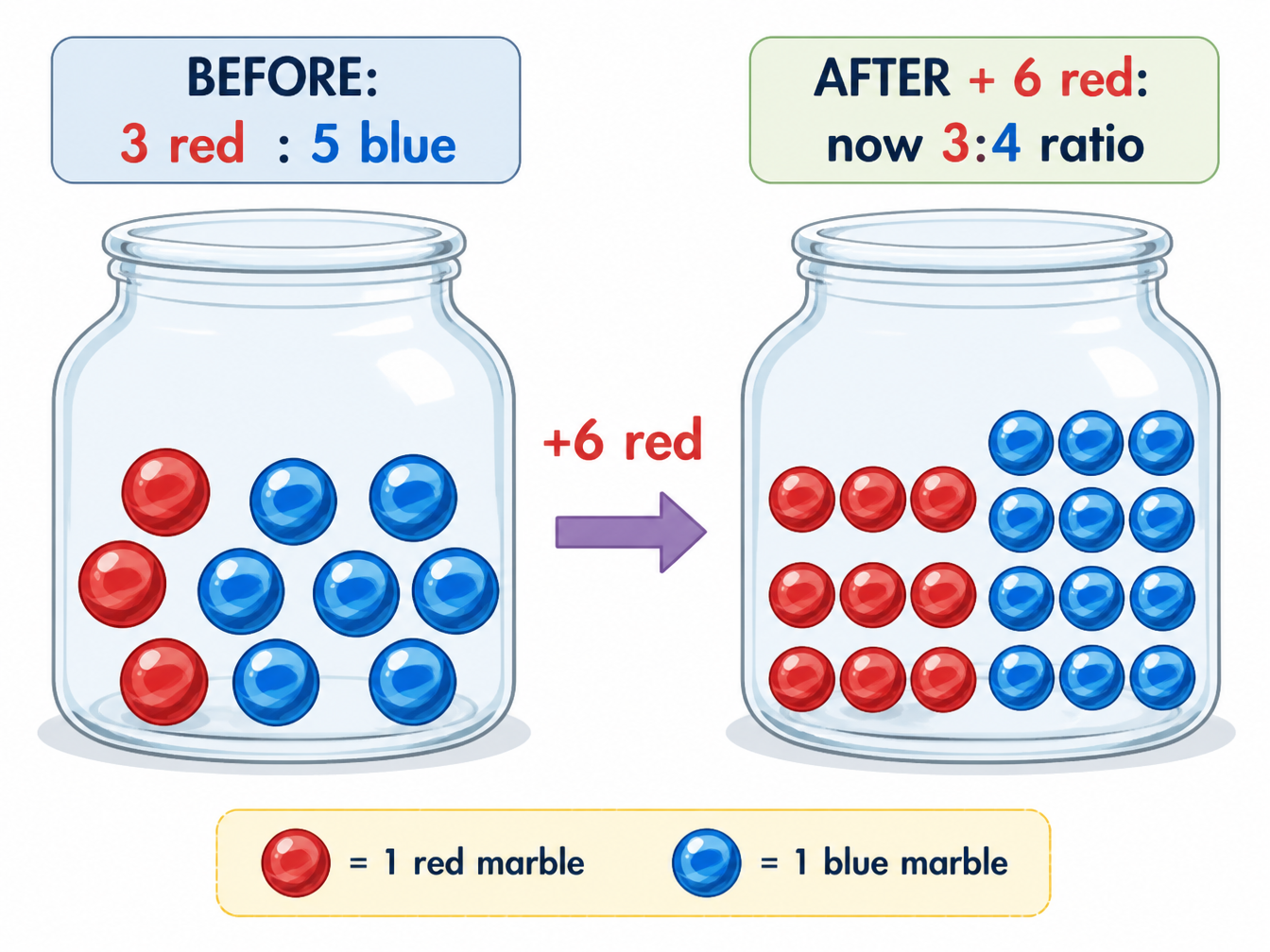
Red and blue marbles are in ratio . After 6 red marbles are added, the ratio becomes . How many blue marbles?
Anchor on the unchanged quantity — blue.
Original: red, blue.
After: red, still blue.
Ratio: .
Cross-multiply: .
Blue marbles .
🔑 Anchor strategy: identify the quantity that doesn't change. Write the new ratio using that fixed anchor and one unknown. The equation falls out.
3.3 Speed, time, distance —
The three forms:
- (distance = rate × time)
2024 Q9 — division word problem
Olivia cuts a cm string into cm pieces. Jeff cuts a cm string into cm pieces. How many more pieces does Olivia have than Jeff?
Olivia: pieces. Jeff: . Difference: . Answer (A). ✅
The average-speed trap
A car travels from A to B at km/h and returns at km/h. What is the average speed?
Wrong: .
Right: average speed = . If is km:
- Time outbound: h
- Time return: h
- Total time: h
- Total distance: km
Average speed km/h.
🔑 Average speed is NOT the average of the speeds. It's harmonic-mean-like. Always use total distance over total time.
3.4 Mixture & money problems
The pattern: two types (cheap/expensive coins, low-/high-% solutions), two facts (count total, value total), set up two equations.
Example
A piggy bank has dimes () and quarters (), coins totaling . How many quarters?
Let = quarters, = dimes.
From the first: . Substitute:
3.5 Time arithmetic — base-60
Time problems aren't decimal arithmetic — hours and minutes carry at , not .
2024 Q7 — worked in full
Katie completed two laps. The first lap took min s. The second took min s. What was her total time?
Add minutes and seconds separately, then carry if seconds .
- Seconds: → write s, carry min.
- Minutes: min.
Total: 8 min 20 s. Answer (D). ✅
🔑 The carry on time problems is , not . Same idea for hours: carries every on and , every on for calendar problems.
Elapsed time — the subtraction case
A movie starts at pm and ends at pm. How long is it?
Borrow hour from the to lend minutes to the :
Movie length: 2 h 45 min.
⚠️ BC G5 covers "duration / elapsed time" informally but does NOT teach base-60 carry/borrow. Gauss expects fluency with this.
3.6 Trap Alerts ⚠️
- Ratio total ≠ sum. "Boys : girls = 3 : 5, class of 24" means , so — not 24 boys.
- Average speed harmonic-mean trap. Always go via .
- Two-stage: identify the anchor. If both quantities change, you'll need two variables and two equations.
3.7 Mnemonic
"Scale by , anchor what doesn't move, total over total for averages."
Practice Set
- (Part A) The ratio of dogs to cats is , and there are dogs. How many cats?
- (Part B) A car drives km at km/h, then km at km/h. Average speed?
- (Part B) Apples and oranges are in ratio . After 9 more apples arrive, the ratio is . How many oranges?
- (Part C) Jamal walks at km/h; his friend cycles at km/h. They start km apart heading toward each other. How long until they meet?
Answers: 1) 18; 2) km/h; 3) Anchor oranges: . Apples . So , oranges = 63; 4) Combined speed 25 km/h, time = = 1.2 h = 1 h 12 min.
End of chapter. Next: Algebra Readiness — Variables, Substitution & Cryptarithms.