By the end of this chapter you will:
- Convert between fractions, decimals, and percents at sight
- Compose percent-of-percent chains correctly
- Read a circle graph and extract the right slice
- Use the complement ("one minus") to dodge messy direct counts
2.0 The BC gap
BC baseline: G5 covers equivalent fractions and decimals to thousandths. G6 adds whole-number percents and discount problems (one-step). What BC does not cover: percent-of-percent chains, weighted-region probability, and complement-counting tricks. Gauss compounds the basics: of of , or "Brett pours half out, then Juanita pours of her glass in". These chains are where students lose points.
2.1 Fluency table — memorize these
| Fraction | Decimal | Percent |
|---|---|---|
2.2 Circle graphs — 2024 Q4
Students were asked to choose their favourite school day. Results: Monday 15%, Tuesday 10%, Wednesday 25%, Thursday 20%, Friday 30%. Which day was chosen by exactly one-quarter of the students?
One-quarter Wednesday. Answer (C). ✅
🔑 Match the fraction to a familiar percent. ; ; .
2.3 Percent-of-percent chains — 2024 Q16
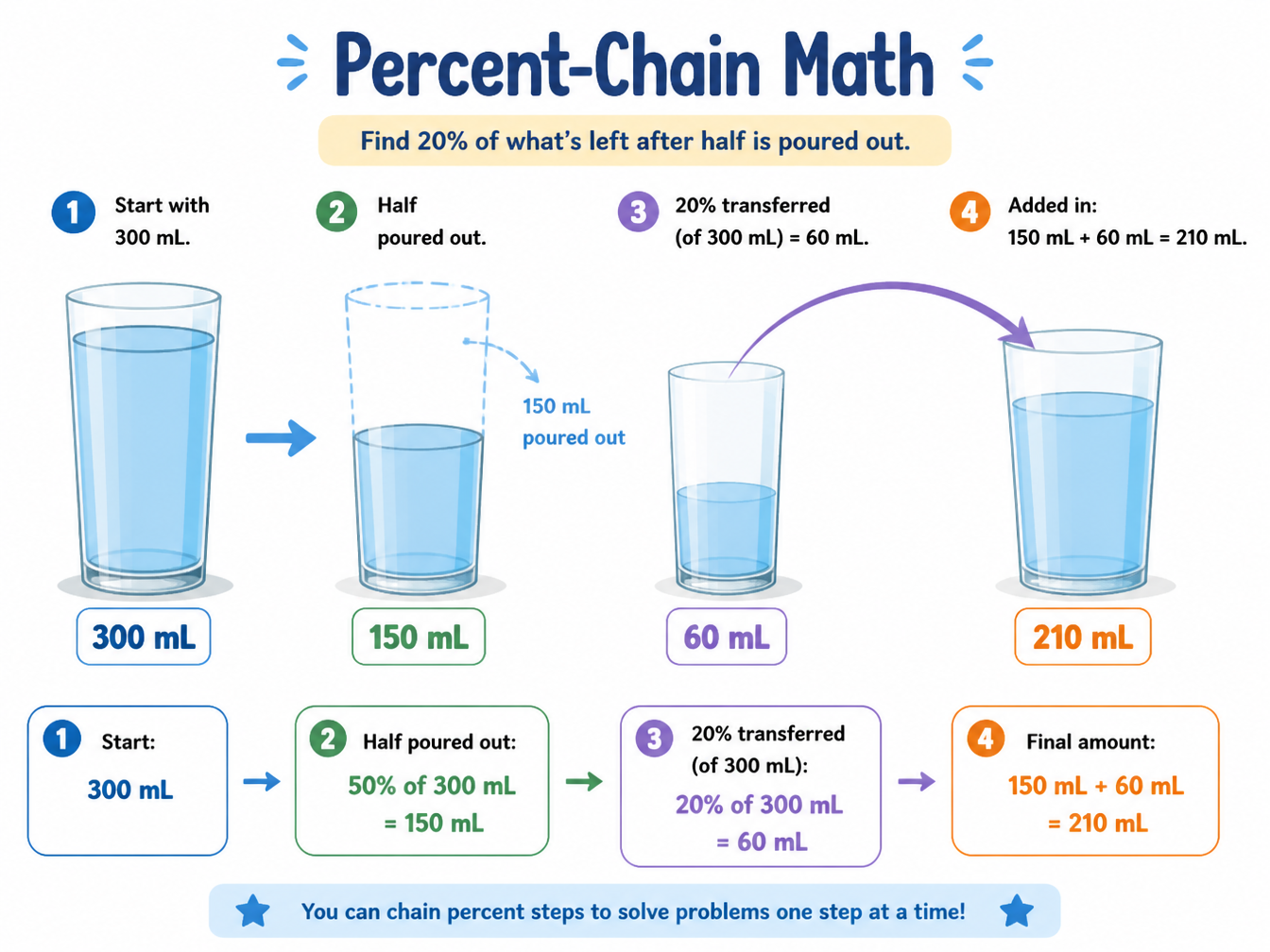
Brett and Juanita each have mL in a glass. Brett pours half of his out. Then Juanita pours of her water into Brett's glass. What volume is in Brett's glass now?
Step 1 — Brett pours half out: mL left.
Step 2 — Juanita pours of her mL: mL transferred.
Step 3 — Brett's glass now: mL. Answer (A). ✅
⚠️ Trap: Juanita's 20% is of her current amount ( mL, untouched), not of Brett's . Read carefully — "her water".
2.4 Complement: "1 minus the easy case"
A spinner is split into 12 unshaded and 3 shaded sections, with each unshaded the size of each shaded. P(shaded) = ? (2024 Q17)
Let one shaded sector be unit; each unshaded is units.
Total area = units.
Answer (D). ✅
🔑 Probability with weighted regions = , NOT . The slice count is irrelevant when slices differ in size.
2.5 Trap Alerts ⚠️
- 20% off then 20% more ≠ original. , not . Successive percent changes don't add, they multiply.
- "% of A" vs "% of B" — read which number the percent applies to.
- Equal-size assumption — only valid when explicitly stated. Spinners look equal in the diagram even when they aren't.
2.6 Mnemonic
"Convert, chain, complement, check the base."
- Convert to whichever form is easiest (fraction beats decimal in Gauss)
- Chain percentages by multiplying the multipliers ()
- Complement for "at least" / hard regions
- Check the base — what does the percent apply to?
Practice Set
- (Part A) of is ____.
- (Part B) After two consecutive price increases, a item costs ____.
- (Part B) A circle graph has slices . Find .
- (Part C) Of apples, are red, are green, the rest are yellow. If of the green ones are sold, how many apples remain in total?
Answers: 1) 60; 2) ; 3) 20; 4) , rounded depending on integer constraint — assume integer apples → 347.
End of chapter. Next: Ratios, Rates & Two-Stage Word Problems.