By the end of this chapter you will:
- Build a factor tree for any integer up to 1000 in under 30 seconds
- Apply divisibility tests for 2, 3, 4, 5, 9, 10, 11 without long division
- Compute GCD and LCM from prime factorizations
- Count the divisors of a number from its prime factorization alone
- Recognize the Gauss problems that "look hard" but reduce to factoring
1.0 Why this chapter is first
BC baseline: G6 introduces factors, multiples, GCF, LCM, divisibility rules, factor trees, and prime factorization — but only at the level of "what is a prime factor?" Gauss demands fluency: prime-factor a number, count its divisors, reason mod small primes, all in under a minute.
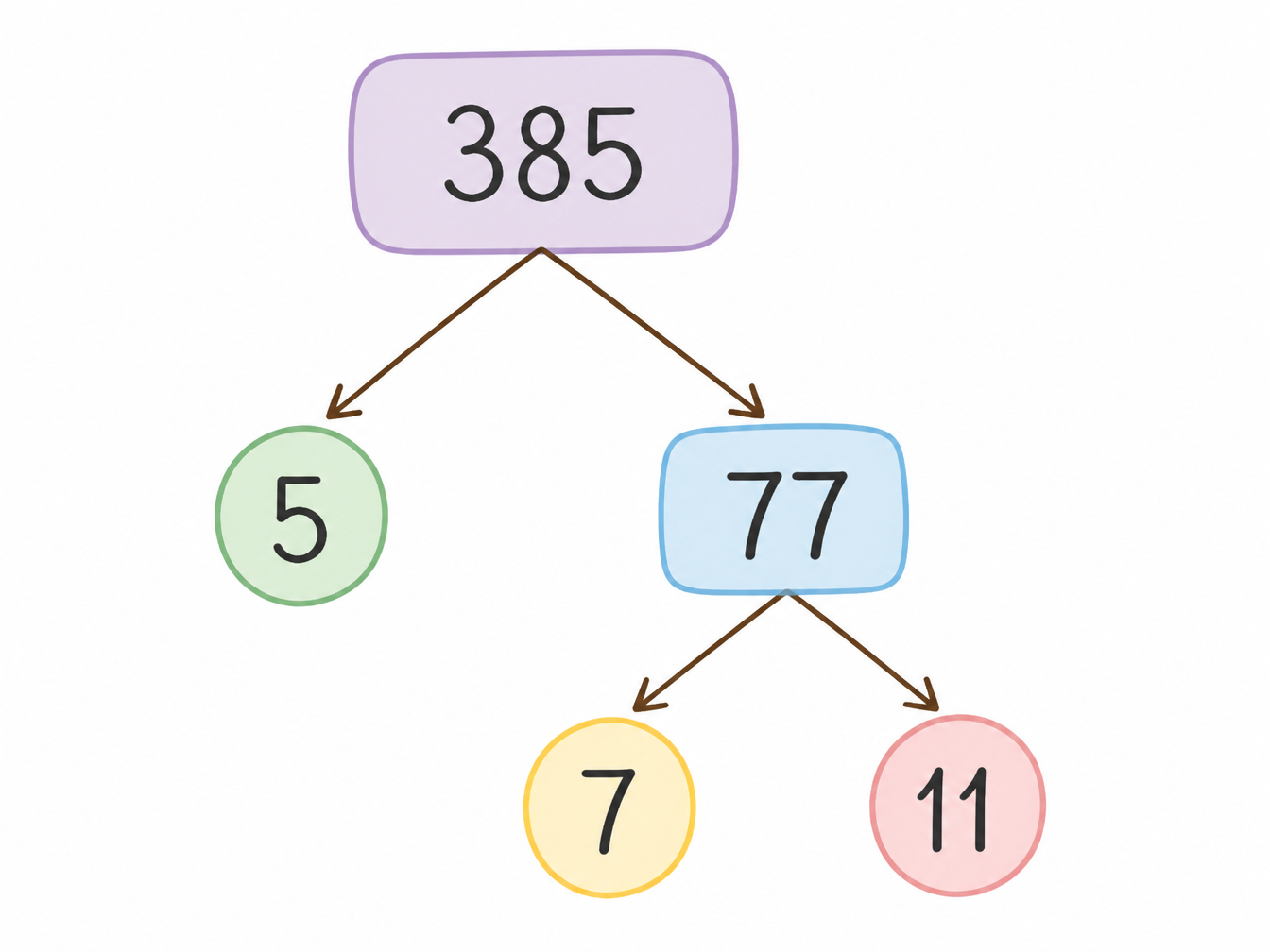
Every recent Gauss 7 paper has at least one question that collapses the moment you write the prime factorization. 2024 Q14: "The number 385 has three prime factors. The sum of these prime factors is…" — a 6-point problem that takes 15 seconds if you know what to do, or 3 minutes of guessing if you don't.
🔑 Lead with factoring. When a Gauss problem mentions a specific number (385, 36, 100, 24, 2024 …), your first move should be: factor it. Often the problem reveals itself.
1.1 Prime numbers — the building blocks
A prime is a positive integer with exactly two divisors: and itself.
| First 12 primes | |
|---|---|
| 1 is NOT prime | (it has only one divisor) |
| 2 is the only even prime | (all other evens are divisible by 2 and themselves and 2) |
🔑 Memorize the primes up to 50. They are: . Fifteen numbers — you can do this on the bus tomorrow.
Trap: 51 is not prime (). Neither is 57 () or 91 (). These three numbers fool more students than any other.
1.2 Factor trees — the procedure
To factor :
       385
      /   \
     5    77
         /  \
        7   11
Pull out any prime divisor you can spot, write the cofactor, repeat. Order doesn't matter — every path gives the same set of primes. Result:
2024 Q14 asks for the sum of the prime factors: . Answer (D). ✅
Practice these on sight:
| Prime factorization | |
|---|---|
1.3 Divisibility rules — the test cheat sheet
| Divisor | Test |
|---|---|
| 2 | Last digit is |
| 3 | Digit sum divisible by 3 |
| 4 | Last two digits form a number divisible by 4 |
| 5 | Last digit is or |
| 6 | Divisible by 2 and 3 |
| 8 | Last three digits form a number divisible by 8 |
| 9 | Digit sum divisible by 9 |
| 10 | Last digit is |
| 11 | Alternating sum of digits divisible by 11 |
Example — divisibility chaining
Is divisible by ? Digit sum . 8 is not divisible by 3, so no.
Is divisible by ? Last two digits , and . Yes — .
Is divisible by ? Alternating sum . Not divisible by 11.
🔑 The digit sum is also useful for the digit-sum problem itself. 2024 Q1 asks: "When the four digits of 2024 are added, the result is…" Answer: . (B). ✅
1.4 GCD & LCM via prime factorization
Once you have prime factorizations, GCD and LCM are mechanical.
| GCD (greatest common divisor) | LCM (least common multiple) | |
|---|---|---|
| Take | The smaller exponent for each shared prime | The larger exponent for each prime |
| Example | ||
Identity worth remembering: .
When LCM shows up on Gauss
A bell rings every 6 minutes; a chime every 10 minutes. They both go off at 12:00. When do they next ring together?
minutes → next at 12:30.
Pattern: "two recurring events both happen at time T, when is the next coincidence?" → LCM of their periods.
1.5 Counting divisors
If then the number of divisors of is
Example: . Number of divisors . Verify: . ✓
This is the formula you reach for whenever a Gauss problem asks "how many divisors does have" or "for how many integers does divide ".
1.6 Worked Examples (Part A → Part B → Part C)
Example 1 — Part A flavor (2024 Q10)
A number is randomly chosen from the list . The probability that the chosen number is divisible by , or by , or by both, is …
Setup: divisibility = factoring + listing.
Divisible by 2: .
Divisible by 3: .
Union (don't double-count ): — 6 numbers out of 9.
Probability . Answer (C). ✅
Example 2 — Part B flavor
What is the smallest positive integer that has exactly divisors?
Strategy: factors as . Each factoring corresponds to an exponent pattern.
| Exponent pattern | Smallest |
|---|---|
| ✅ | |
| ✅ |
Comparing: , so answer is 60.
🔑 Smaller-base-bigger-exponent gives smaller , but only up to a point — try a few patterns and pick the minimum.
Example 3 — Part C flavor (2024 Q25, simplified)
Suppose are different prime numbers, and , with . The expressions , , , are also all prime. Find if the answer is among .
Key parity observation: is even, and most primes are odd.
If are all odd, their sum is odd, contradicting (even). So one of them is 2.
The smallest is the candidate: . Then .
Now must be prime. So and are both prime (a "twin-prime" condition).
The answer asks for . Without working out the rest, observe that any valid must satisfy where is a small twin-prime partner. Trying gives (prime ✓), and — not on the list, so try , giving (not prime). Continue: → (prime ✓), . Eventually with a different distribution... full solution requires checking all twin-prime cases.
🔑 Lesson: in Part C number-theory problems, parity is almost always the first reduction. "All primes are odd except 2" forces small primes into the equation.
1.7 Trap Alerts ⚠️
- is not prime. Don't include it in factorizations.
- — these LOOK prime and aren't. Memorize: , , , , .
- "Three prime factors" can mean three distinct or three with multiplicity. Read carefully. has three distinct. has one distinct but "three" with multiplicity.
- Divisibility by 6 needs BOTH 2 AND 3, not just digit-sum-divisible-by-6.
1.8 Mnemonic
"Factor first. Then the problem tells you what to do."
- When a specific integer appears → factor it on scratch paper
- Digit-sum and last-digit handle divisibility-by-small
- GCD = small exponents; LCM = big exponents
- Number of divisors = product of (exponent + 1)
Practice Set (10 problems, mixed difficulty)
- (Part A) Find the sum of the prime factors of .
- (Part A) What is the smallest 3-digit number divisible by both and ?
- (Part A) How many of the numbers are divisible by exactly one of or ?
- (Part B) Find .
- (Part B) Find the LCM of , , and .
- (Part B) How many divisors does have?
- (Part B) A number leaves remainder when divided by and remainder when divided by . What is its smallest positive value?
- (Part C) Find the smallest positive integer that has exactly divisors.
- (Part C) For how many values of with does share no factor greater than with ?
- (Part C) Two clocks ring at intervals of and seconds, starting together at . How many times will they ring together in the next hour?
Answers: 1) 10; 2) 108; 3) 6; 4) 42; 5) 60; 6) 18; 7) 17; 8) 144; 9) 26; 10) 8 (every 210 seconds = 3.5 min).
End of chapter. Next: Fractions, Decimals & Percent — Competition Techniques.