By the end of this chapter you will:
- Translate a word problem into a one-variable equation in under a minute
- Solve linear equations using the balance method, fluently
- Crack cryptarithms (letter-digit puzzles) by column-by-column reasoning
- Use bounded search to find all integer solutions
4.0 Why this chapter is the biggest leverage point
BC baseline: G5 teaches one-step equations with one variable like . G6 reinforces this with the balance method. But BC stops there — there are no two-step equations (e.g. ), no cryptarithms, and no bounded enumeration. Gauss expects all three.
Every recent paper has 3–4 questions that are trivial with algebra and slow without.
2024 Q2 starts with the gentlest possible: "If , the value of is …" — just substitution. By Q12 the same skill solves "The length of a rectangle is twice its width. The perimeter is 120 cm. The width is …" in two lines.
🔑 The mental shift: stop asking "what number is it?" Start writing "let = the thing I don't know" — then the problem hands you the equation.
4.1 From words to a variable — the translation table
| English phrase | Algebra |
|---|---|
| "The number" / "an unknown" | |
| " more than " | |
| " less than " | |
| "twice " / "double " | |
| "three times " | |
| " tripled and then increased by " | |
| "the sum of and " | |
| "the product of and " | |
| " divided by " | |
| "half of " | |
| " is " | |
| " is at least " |
⚠️ Trap: "Five less than " means , not . Read direction carefully.
Substitution warm-up — 2024 Q2
"If , the value of is…"
Substitute: . (C). ✅
A six-second problem if you don't overthink it. Notice: Gauss starts almost every paper with a substitution Q to verify the student can do this.
4.2 The balance method — solving one-variable equations
Rule: whatever you do to one side, do to the other. The equation stays "balanced".
| Step | Action |
|---|---|
| 1 | Move all -terms to one side |
| 2 | Move all constants to the other side |
| 3 | Divide by the coefficient of |
Example — solve
Example — solve
Subtract from both sides: .
Add to both sides: .
Divide by : .
4.3 Setting up from a word problem — 2024 Q12
"The length of a rectangle is twice its width. The perimeter of the rectangle is cm. The width of the rectangle is …"
Step 1 — Name the unknown. Let = the width (in cm).
Step 2 — Express what you know in terms of it.
- Length
- Perimeter
Step 3 — Write the equation from the constraint.
Step 4 — Solve.
Answer (A). ✅
🔑 Always name the variable first. Half the difficulty of word problems disappears once you pin down what stands for.
4.4 Inverse mean — 2024 Q13
"Eloise purchased a number of water hand pumps at a mean price of $85 per pump. She spent a total of $765. How many pumps did she purchase?"
Recall: , so .
Let = count of pumps.
Answer (C). ✅
🔑 Inverse mean: when the mean is given and you want the count, divide total by mean. When the mean is given and a single missing item is asked, multiply mean by count then subtract the known sum.
4.5 Cryptarithms — letters stand for digits
A cryptarithm is an arithmetic puzzle where each letter is a single digit, and the same letter means the same digit throughout. The trick is column-by-column reasoning with carries / borrows.
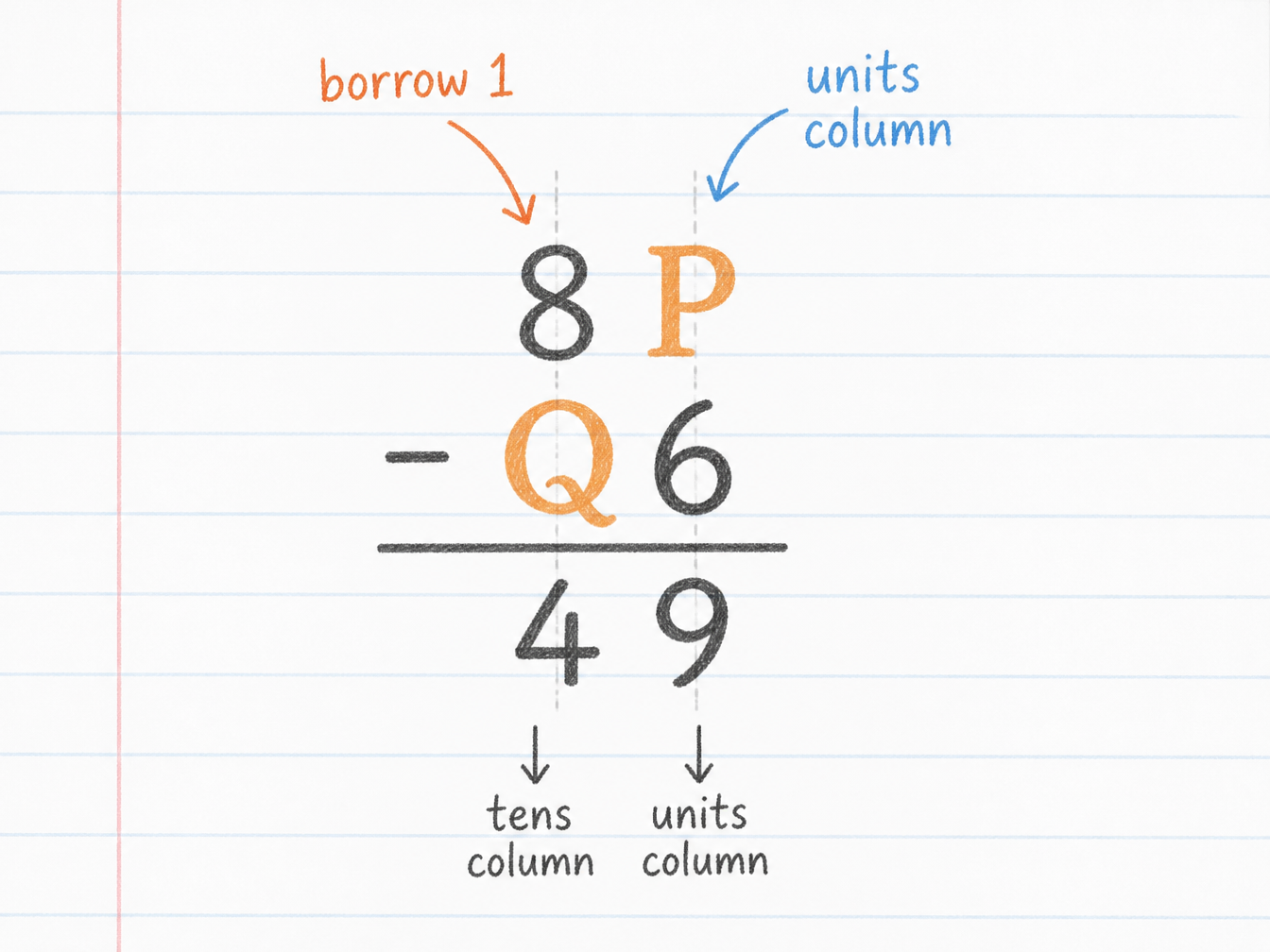
2024 Q11 — worked in full
In the subtraction of two-digit numbers, the letters and each represent a single digit:
Find .
Step 1 — Units column. We need (units digit). That requires , which is impossible for a single digit. So we must have borrowed from the tens column: .
Step 2 — Tens column. After lending to the units column, the tens row has available. So .
Step 3 — Verify. . ✓
Answer (D). ✅
Cryptarithm playbook
- Start at the units column. It has no carry coming in from the right.
- Track each carry / borrow explicitly.
- Use bounds: each letter is a digit –, and leading letters are –.
- Verify by plugging back in. Always.
4.6 Bounded search — when algebra alone isn't enough
Sometimes the equation has multiple integer unknowns and you can't isolate one. Then enumerate the smaller side.
Example
Find all positive integers with .
must be small enough that stays positive: .
Also, must be divisible by , so must be divisible by , so must be a multiple of : .
Three solutions: .
🔑 Bounded-search technique: combine divisibility (from coefficients) with positivity bounds. Often you go from "infinite solutions" to "a 3-row table" in two lines.
4.7 Trap Alerts ⚠️
- "Less than" reverses the order. "5 less than " is , not .
- Don't forget to define your variable. Writing "" without saying "let = width" loses marks on Olympiad solutions and confuses you mid-problem.
- Carries and borrows are easy to miss. In Q11 above, students who forget the borrow get , which is impossible, and conclude "no answer" instead of going back.
- Parity in mixed problems — "": since is even and have parity tied to , you can also reason mod 2 to cut cases.
4.8 Mnemonic
"Name it, express it, equate it, solve it."
- Name the unknown (let = …)
- Express the other quantities in terms of
- Equate using the constraint sentence
- Solve by balance method
Practice Set (10 problems, mixed difficulty)
- (Part A) If , find .
- (Part A) Solve: .
- (Part A) Sarah is years older than her brother. The sum of their ages is . How old is Sarah?
- (Part B) Solve: .
- (Part B) A rectangle has length cm more than its width. Its perimeter is cm. Find the width.
- (Part B) In the cryptarithm , find .
- (Part B) The sum of three consecutive integers is . What is the largest?
- (Part C) Find all positive integer solutions to .
- (Part C) In , where are digits, find .
- (Part C) Three numbers have mean . The smallest is and the largest is twice the middle one. Find the middle number.
Answers: 1) 17; 2) 5; 3) 14; 4) 5; 5) 12; 6) 11; 7) 33; 8) not integer, valid: — check: ≤ 50 → ∈ {2,4,6}: — re-derive: . ; ; . So ; 9) Try : not integer, not, not, not, not, , so : sum . not, not, not. ✓; 10) Let middle = , largest = . Sum: .
End of chapter. Next: Geometry I — Angles, Triangles & Symmetry.