By the end of this chapter you will:
- Use the angle-sum theorems for triangles, quadrilaterals, and straight lines
- Spot vertical and parallel-line angle relationships
- Chase angles through isosceles chains
- Count lines of symmetry for regular shapes
5.0 The angle-chasing mindset
BC baseline: G6 covers angle measurement and classification (acute, right, obtuse, reflex) and polygon angles. What BC doesn't teach: chain reasoning (" and the triangle is isosceles → therefore → therefore "), parallel-line angle theorems (Z, F, C shapes), or counting lines of symmetry. Those three skills are the heart of Gauss geometry.
Most Gauss geometry questions in Parts A and B are angle chases: you're given a few angles, told about parallel lines or isosceles triangles, and asked to find . The solution path is usually 2–3 short deductions.
🔑 Mark up the diagram. Annotate every angle you can deduce — equal marks for equal angles, parallel arrows on parallel lines. The answer often falls out the moment the diagram is fully labeled.
5.1 The angle-sum facts
| Shape | Angle sum |
|---|---|
| Straight line | |
| Right angle | |
| Full turn | |
| Triangle | |
| Quadrilateral | |
| Regular -gon | (interior); each angle |
2024 Q6 — straight angle
is a straight angle. Find given the diagram shows adjacent to .
Straight angle , so . Answer (E). ✅
5.2 Vertical, parallel & corresponding angles
Vertical angles (formed by two intersecting lines) are equal.
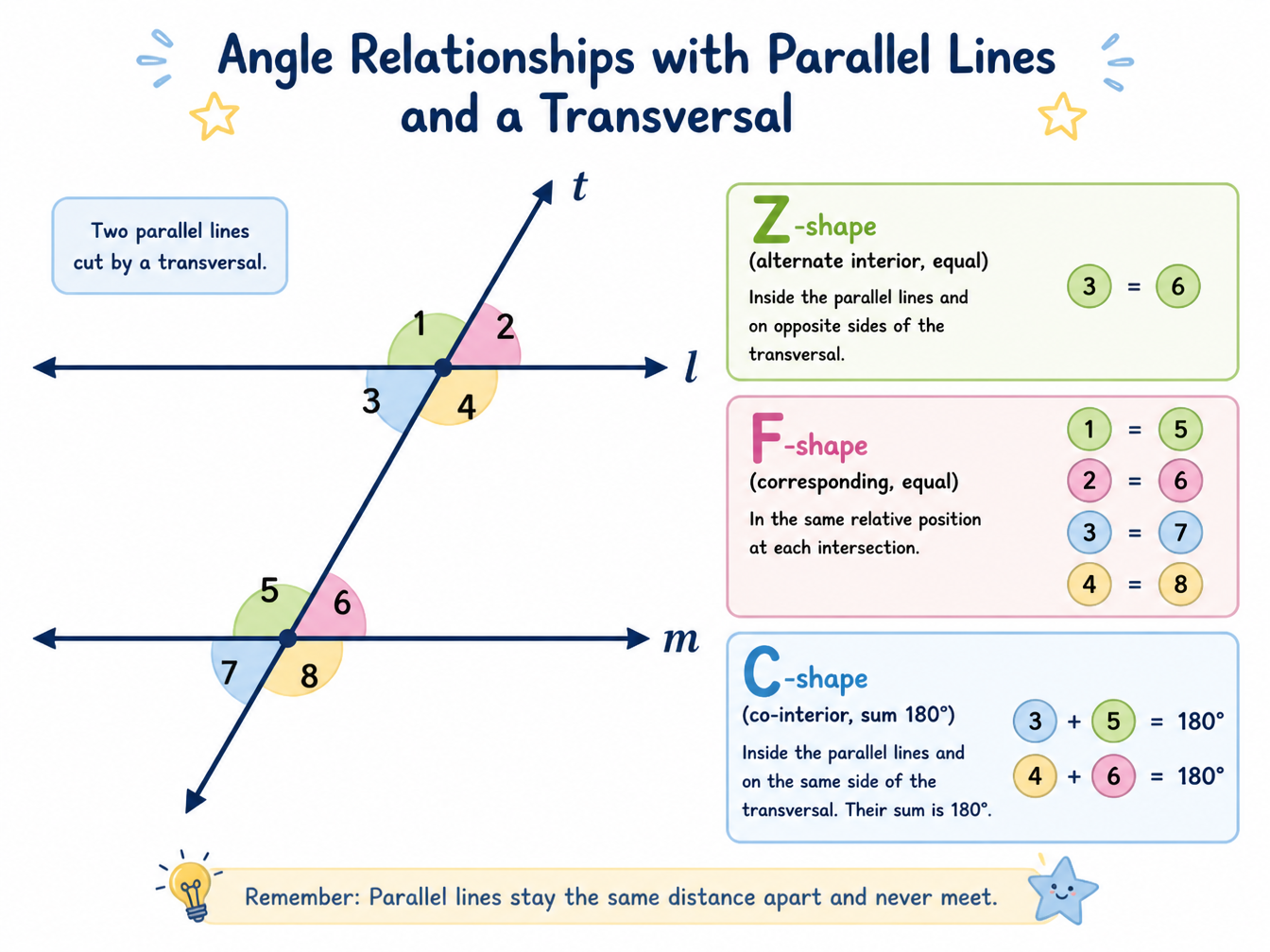
Parallel-line angle pairs (where a transversal crosses two parallel lines):
| Pair | Relationship |
|---|---|
| Corresponding angles | Equal |
| Alternate interior angles | Equal |
| Co-interior (same-side interior) angles | Supplementary () |
🔑 If the problem mentions parallel lines, look for the , , or shape formed by the transversal. The gives alternate-interior (equal), the gives corresponding (equal), the gives co-interior (sum ).
5.3 Isosceles & equilateral chains
Isosceles theorem: in a triangle with two equal sides, the angles opposite those sides are equal.
Equilateral: all three sides equal all three angles equal .
Example
In , and . Find .
Since , .
.
5.4 Lines of symmetry
A line of symmetry is a line such that folding along it makes the two halves coincide.
| Shape | Number of lines of symmetry |
|---|---|
| Equilateral triangle | |
| Square | |
| Regular pentagon | |
| Regular hexagon | |
| Regular -gon | |
| Circle | infinite |
| Rectangle (non-square) | |
| Non-square rhombus | |
| Parallelogram (non-rhombus) | |
| Isosceles trapezoid | |
| Scalene triangle |
2024 Q3 — vertical line of symmetry
Which of the following shapes has a vertical line of symmetry?
The answer is the rectangle in choice (E) (the standard textbook rectangle, with its sides parallel to the page edges and a clean vertical mirror axis through its center).
⚠️ Trap: a parallelogram looks symmetric but typically isn't — it has rotational symmetry but no reflective lines of symmetry unless it's a rhombus or rectangle.
5.5 Trap Alerts ⚠️
- Diagrams are NOT to scale. Don't measure angles with a protractor on the test booklet; you'll be misled.
- Vertical angles ≠ supplementary angles. Vertical = opposite (equal). Supplementary = adjacent on a straight line (sum to 180°).
- Two-sides-equal-two-angles-equal runs both directions: equal angles also imply equal sides.
- Parallelogram is NOT symmetric in the reflection sense (unless it's a rectangle or rhombus).
5.6 Mnemonic
"Triangle = 180°, quad = 360°, equal sides give equal angles, look for /C with parallels."
Practice Set
- (Part A) In a triangle, two angles are and . Find the third.
- (Part B) In , and . Find .
- (Part B) Two parallel lines are cut by a transversal. One pair of co-interior angles measures and . Find .
- (Part C) In an isosceles triangle with , the angle bisector from meets at . If , find .
Answers: 1) 70°; 2) Since , , so ; 3) ; 4) The bisector is perpendicular to the base in an isosceles triangle, so .
End of chapter. Next: Geometry II — Area, Perimeter & Scaling Laws.