By the end of this chapter you will:
- Compute areas of squares, rectangles, triangles, parallelograms, circles from memory
- Break composite & shaded regions into add/subtract pieces
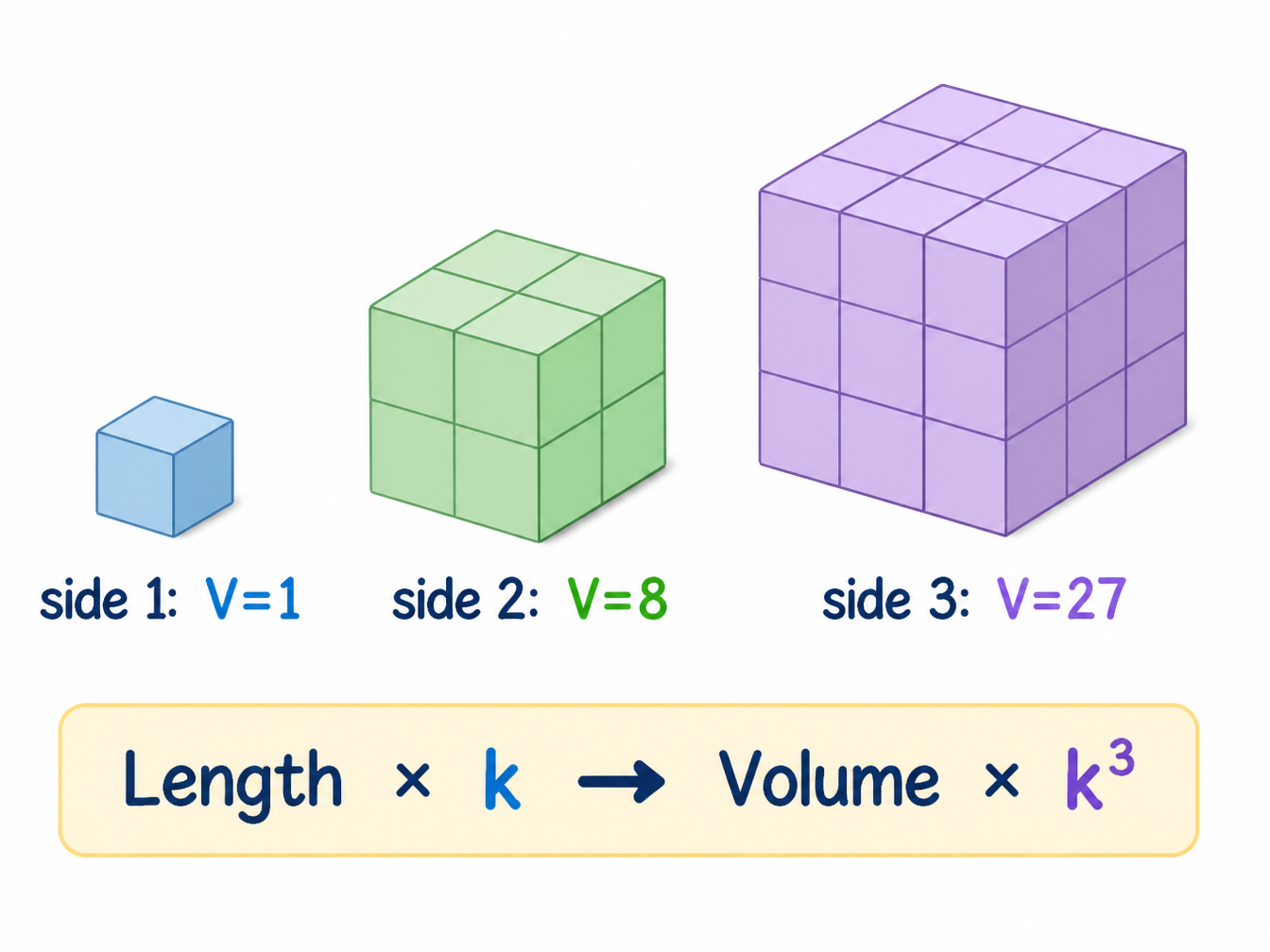
- Use the scaling law: length → area → volume
- Solve perimeter problems that hide a one-variable equation
6.0 The BC gap
BC baseline: G5 teaches area of squares and rectangles, plus volume informally. G6 adds triangle, parallelogram, trapezoid areas and volume in cm³ / m³ / mL / L. What BC does not teach: the scaling law (), composite shaded regions, surface area, nets, painted-cube casework, and grid-counting formulas (toothpicks). All four are Gauss staples.
6.0.1 The two formulas to never forget
Everything else builds from these.
2024 Q5 — square area
A square with side length has an area of …
. Answer (E). ✅
6.1 Area formulas
| Shape | Area |
|---|---|
| Square | |
| Rectangle | |
| Triangle | |
| Parallelogram | |
| Trapezoid | |
| Circle |
Perimeter (the boundary length):
- Rectangle:
- Circle (circumference):
6.2 Composite & shaded regions
The two moves: add simple regions, or subtract simpler-from-bigger.
Example
A square of side has a circle of radius inscribed in it (touching all four sides). Find the shaded area outside the circle but inside the square.
Shaded = Square − Circle = .
🔑 The subtraction approach is almost always cleaner than direct. When you see an annulus, an L-shape, a square minus a triangle, try whole minus inner.
6.3 The scaling law — the Part B move
If every length scales by a factor , then every area scales by , and every volume scales by .
2024 Q15 — radius tripled
A circle has radius . If the radius is tripled, the area of the original divided by the area of the new is …
Original radius , new radius . Lengths scaled by , so areas scale by .
Answer (C). ✅
🔑 Spotting scaling: any sentence with "doubled / tripled / halved / scaled" applied to a length. Don't compute both areas separately — use .
6.4 Perimeter as a one-variable equation
Perimeter problems often hide a linear equation. Set up, solve.
2024 Q12 (revisited from Ch. 4)
Length is twice the width, perimeter is cm.
cm.
6.5 3D — nets, surface area, volume, painted cubes
BC G6 introduces volume in cm³ and m³ but does NOT teach surface area or 3D casework. Gauss expects both.
Surface area of a rectangular box
A box with edges has surface area
For a cube of edge : , .
Nets
A net is an unfolded view of a 3D solid. Practice: a cube net has squares in a cross or T arrangement. Other prisms unfold into rectangles + the two cap shapes.
Recognize from sight: a cube has distinct nets (up to rotation/reflection). You don't need to memorize them — just know "if I fold these squares back up, do they form a cube?"
Painted-cube casework — 2024 Q23 (worked in full)
A rectangular prism with integer edges is painted on all 6 faces, then cut into unit cubes. Fifty unit cubes have no paint. What is the mean of all possible values of ?
The "no paint" cubes are exactly the interior cubes — those not touching any face. The interior dimensions are (each face peels off one layer on each side). So we need
with (so the interior dimensions are ).
Factor 50: . Unordered triples of positive integers with product :
| (= above) | — | |
Distinct volumes: . Mean .
Answer (B) 310. ✅
🔑 The interior-dimension trick is the entire problem. The moment you write "", it's a factor-counting exercise.
6.6 Grid-counting formulas — 2024 Q22
In a grid of squares, toothpicks are used: outer and inner. If toothpicks make a grid, what % are inner?
Toothpick count for an grid (rows × columns of squares):
| Quantity | Formula |
|---|---|
| Total toothpicks | |
| Outer (perimeter) | |
| Inner | total outer |
Verify on : total ✓ outer ✓ inner ✓.
Apply to :
- Total:
- Outer:
- Inner:
Percentage inner: . Answer (E) 91%. ✅
🔑 Grid-counting generalizes to lattice points, gridlines, paths — always count the horizontals and verticals separately, then add.
6.7 Trap Alerts ⚠️
- Area scales by , NOT . Doubling all sides quadruples area.
- Volume scales by . Doubling all dimensions of a box gives volume.
- Triangle's and must be perpendicular. The base and the height to that base form a right angle — not any two sides.
- The "area divided by area" of similar figures equals , not .
- Circumference vs area — is a length, is an area. Don't swap.
6.8 Mnemonic
", , — and becomes becomes ."
Practice Set
- (Part A) Find the area of a rectangle with length and width .
- (Part B) A triangle has base and height . Find its area.
- (Part B) The side of a square is doubled. The new area is how many times the old?
- (Part C) The radius of a sphere is multiplied by . The new volume divided by the original is …
Answers: 1) 40; 2) 42; 3) 4; 4) .
End of chapter. Next: Patterns, Sequences & Modular Periodicity.