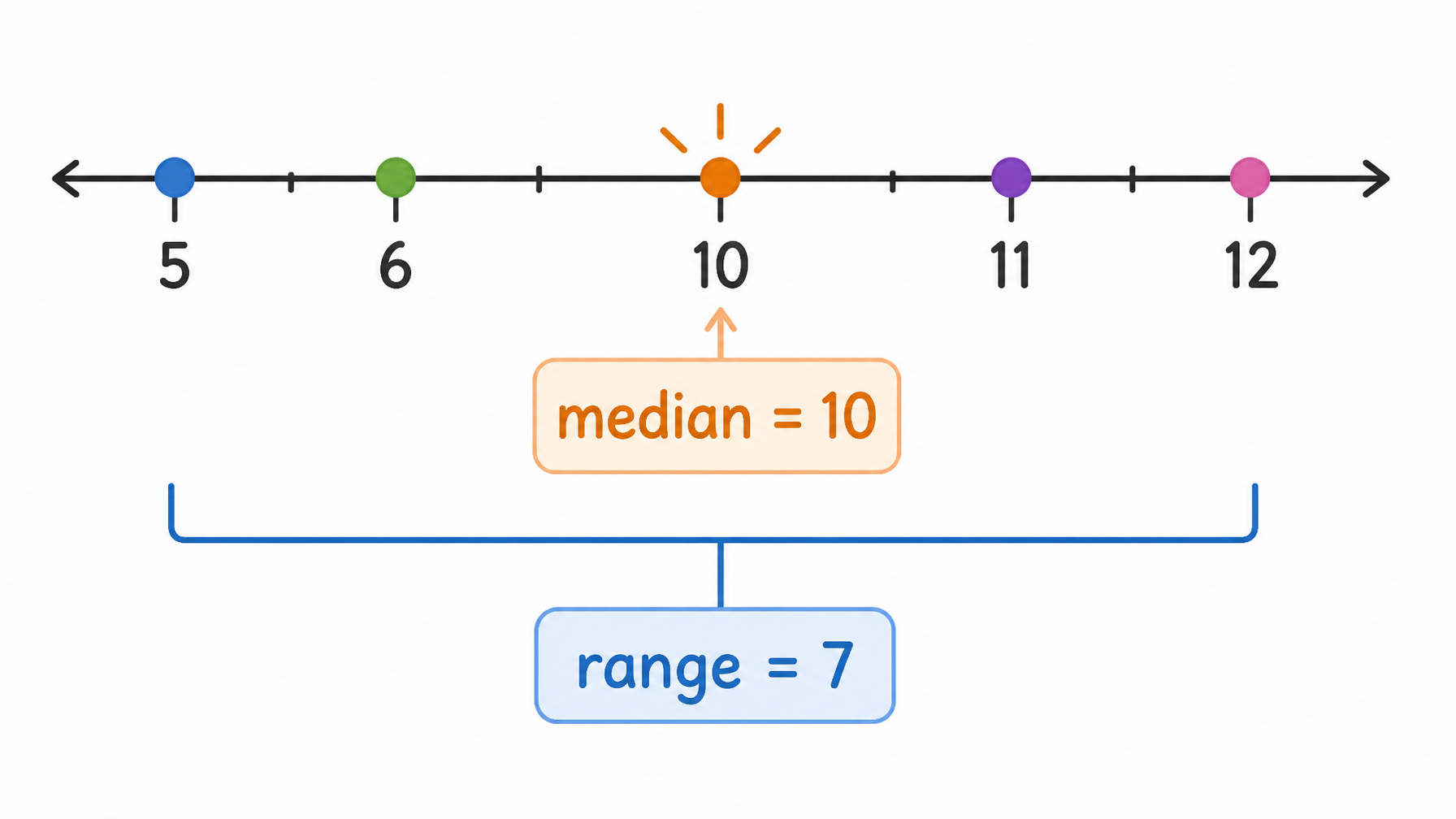
By the end of this chapter you will:
- Compute mean, median, mode, range from a list of numbers
- Run mean problems in both directions (forward and inverse, including missing-term)
- Compute probabilities for equally-likely AND weighted outcomes
- Use tree diagrams for multi-stage probability
- Optimize under median + range constraints ("smallest possible …")
9.0 The BC gap: data summary statistics
⚠️ BC G5 and G6 contain NO instruction on mean, median, mode, or range. Probability is touched lightly. Yet Gauss 7 puts at least one mean/median/range question on every paper.
This chapter is therefore mostly new material for a BC student.
9.1 The four summary statistics
Given a list of numbers :
| Statistic | Definition | Example for |
|---|---|---|
| Mean (average) | ||
| Median | Middle value when sorted | (3rd of 5) |
| Mode | Most frequent value | |
| Range |
Even-count median
For (even count), median = average of the two middle: .
🔑 Always sort first. Median and range are about the sorted order, not the order given.
9.2 Mean — forward direction
Example
Five students scored . Find the mean.
Sum . Mean .
9.3 Mean — inverse directions
The mean formula has three quantities (sum, count, mean). Give any two; find the third.
| Given | Find | Formula |
|---|---|---|
| Mean and sum | Count | |
| Mean and count | Sum | |
| Mean, count, and partial sum | Missing item |
2024 Q13 — inverse mean (find count)
"Eloise purchased a number of water hand pumps at mean price $85, total spent $765. How many pumps?"
Answer (C). ✅
Example — missing term
Five numbers have mean . Four of them are . Find the fifth.
Sum needed = . Known sum . Fifth .
Example — adding one changes the mean
Six numbers have mean . A seventh is added and the mean becomes . What is the seventh number?
Old sum = . New sum = . Seventh = .
9.4 Median + range optimization — 2024 Q19
"Five different integers in a list have a median of and a range of . What is the smallest possible integer?"
Sort (strictly distinct).
- Median =
- Range = , so
- Since , we need , so
Try : , but is impossible. Fail.
Try : , strictly between and — no integer. Fail.
Try : , , — OK.
Smallest is 5. Answer (B). ✅
🔑 "Smallest possible" optimization recipe:
- Sort and assign variables.
- Push the target variable to its extreme bound from the constraints.
- Check feasibility (especially distinctness + integer-ness).
- Increment if infeasible.
9.5 Probability — equally likely outcomes
2024 Q10
"From , = ?"
Favorable: — 6 values. Total: 9.
Answer (C). ✅
9.6 Probability — weighted outcomes (2024 Q17)
When outcomes are NOT equally likely (spinners with unequal slices, biased coins, regions of different sizes), use weights (areas, sizes) instead of counts.
"A spinner has unshaded sections and shaded sections, each unshaded being times the size of each shaded. P(shaded)?"
Let one shaded slice be unit. Each unshaded is units.
- Shaded total weight:
- Unshaded total weight:
- Total:
Answer (D). ✅
⚠️ Trap: do NOT compute . The slices are different sizes.
9.7 Multi-stage probability — tree diagrams
For sequential events: multiply along a branch, add across branches.
Example — two draws without replacement
A bag has 3 red, 2 blue balls. Draw 2 without replacement. P(both red)?
Example — "at least one" via complement
Same bag. P(at least one red in two draws)?
Complement = "no red" = both blue.
🔑 "At least one" is the canonical signal to use the complement.
9.8 Mode — when does it matter?
Mode shows up rarely on Gauss (BC ignores it too), but be ready:
- Unique mode: one value appears more often than any other
- Bimodal: two values tied for most frequent
- No mode: every value appears the same number of times
Gauss flavor: " has a unique mode of . What are the possible values of ?" — forces to each appear time and not equal .
9.9 Trap Alerts ⚠️
- "Different integers" = strictly distinct. No ties allowed.
- Median needs sorting first. Don't read the median off an unsorted list.
- Even-count median is the AVERAGE of the two middles, not the lower or upper one.
- Weighted ≠ equal slices. When sizes differ, weights replace counts.
- Without vs with replacement changes the second draw's denominator.
- The mode might not exist or might tie — don't assume uniqueness.
9.10 Mnemonic
"Sum-over-count for mean, sort-and-pick for median, frequency for mode, max-minus-min for range — and complement for 'at least'."
Practice Set (10 problems, mixed difficulty)
- (Part A) Find the mean of .
- (Part A) Find the median of .
- (Part A) Find the range of .
- (Part A) A coin is flipped twice. P(at least one heads)?
- (Part B) Six numbers have mean . After removing one, the mean of the remaining 5 is . What was the removed number?
- (Part B) A spinner has 4 equal red sections and 1 blue section. P(red on 2 spins)?
- (Part B) Find the median of .
- (Part C) Five different positive integers have mean and median . What is the largest possible value?
- (Part C) Three numbers have mode and mean . The smallest is at least . What are the three numbers if uniquely determined?
- (Part C) A bag has 5 red and 3 blue balls. Two are drawn without replacement. P(same color)?
Answers: 1) 8; 2) sort → , median 7; 3) ; 4) ; 5) sum was 150, after removal is 120 → removed = 30; 6) ; 7) (4+6)/2 = 5; 8) Sum . . Minimize to maximize . Min: (distinct, < 9), (min > 9). Sum so far , so ; 9) Mode unique → at least two s. Three numbers with . Mean → sum → . But smallest , and we'd need smallest so → . But contradicts smallest. So with , smallest is ✓. . Numbers: ; 10) .
End of chapter. Next: Test Strategy — 60-Minute Playbook.