By the end of this chapter you will:
- Apply the 2-point blank rule as a strategic floor, not an afterthought
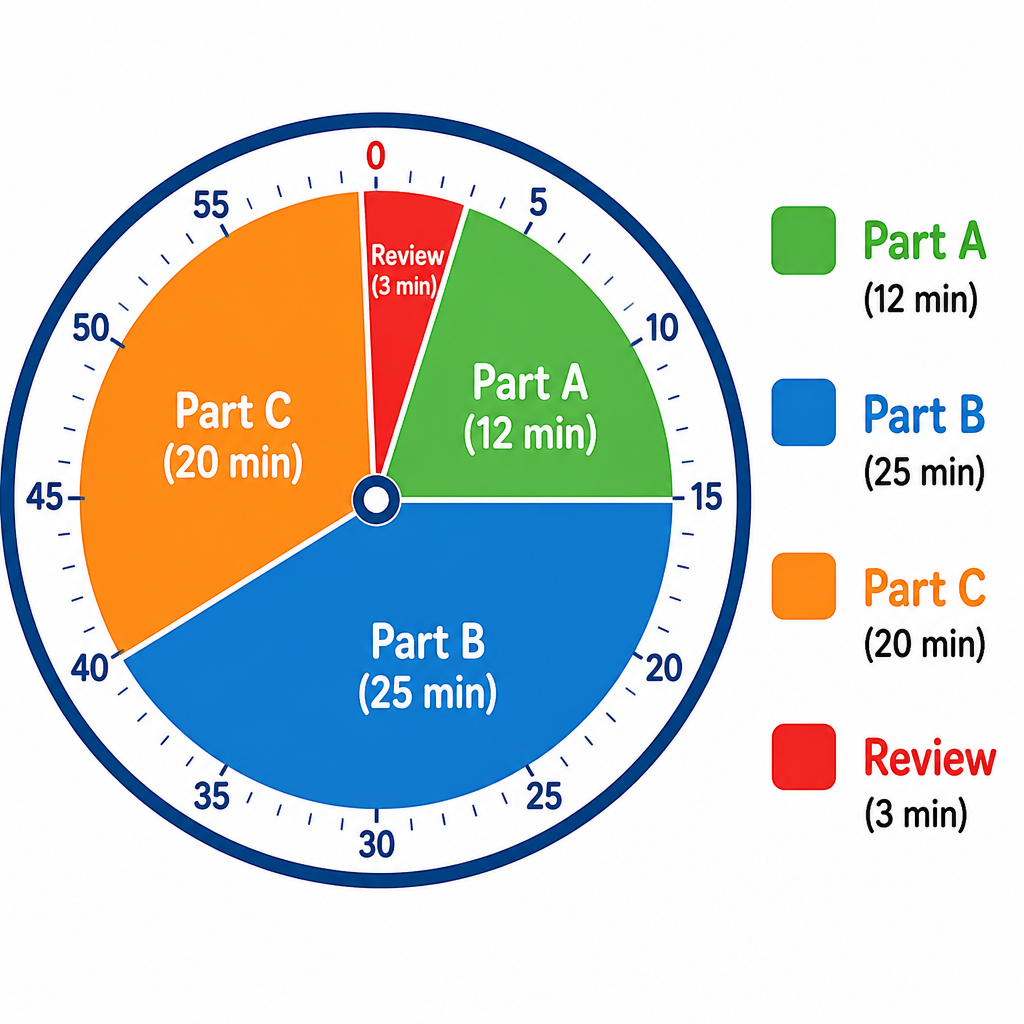
- Pace yourself across Part / C with a realistic clock
- Use the calculator only when it actually helps
- Recognize the four trap families that cost students 20+ points
10.0 The scoring math you must internalize
| Action | Points |
|---|---|
| Correct answer | +5 (Part A) / +6 (Part B) / +8 (Part C) |
| Wrong answer | 0 |
| Blank | +2 (up to 10 blanks; further blanks score 0) |
Implication: if you cannot eliminate any answers, blanking is strictly better than random-guessing.
- Random guess on a 5-choice: expected value point (Part A)
- Blank: points
Even on Part C (+8), random guess = < . Blank wins until you can eliminate at least 2 choices.
🔑 The 4-blank floor: lock in 4 blanks on the four Part-C questions you can't solve. That's +8 in your pocket before you guess at anything.
10.1 Pacing — A → B → C
Total: minutes.
| Block | Time | Pace |
|---|---|---|
| Part A (Q1–10, 5 pts each) | – | min/question |
| Part B (Q11–20, 6 pts each) | – | min/question |
| Part C (Q21–25, 8 pts each) | – | min/question |
| Review & bubble-check | – | min |
Decision points:
- If you're at minute and still on Part A → speed up. Don't crash here.
- If a Part B question burns 4 minutes with no progress → flag and skip. Come back if time allows.
- If you start Part C with minutes → triage hard: read all 5, attempt the 2 that look closest to topics you know.
10.2 Calculator — when it helps and when it doesn't
| Situation | Calculator? |
|---|---|
| Arithmetic (, ) | Sometimes (only if mental math is shaky) |
| Time totals () | Mental — calculators don't add base-60 |
| Casework / enumeration | Useless |
| Cryptarithms | Useless |
| Pattern position () | Mental (or use repeatedly) |
| Mean / total / count problems | Yes, for division |
| Geometry computations () | Yes, with care |
🔑 The calculator is a speed tool, not a thinking tool. If you don't know what to compute, the calculator won't tell you.
10.3 The four Gauss trap families
Trap 1 — "Different" / "distinct"
When the problem says "different integers", the values are strictly distinct. Easy to miss; appears in almost every paper.
2024 Q19: "Five different integers …" — if you accidentally allow , your answer is wrong.
Trap 2 — Average speed ≠ average of speeds
If the average speed of a round trip is what's asked, use . The arithmetic mean of the two speeds is the WRONG answer.
Trap 3 — Off-by-one in patterns / positions
The 23rd term in a repeating pattern uses position (since ). If you get or , recount.
Trap 4 — Diagrams not to scale
The instructions explicitly state: "Diagrams are not drawn to scale." Trust the labeled angles and lengths, not the visual proportions.
10.4 The pre-test 3-minute routine
When you open the booklet:
- Read the entire test for 60 seconds — note which Part C looks hardest.
- Flag your 4 planned blanks in pencil — usually 4 of the 5 Part-C questions, or some hard Part B (this is your point floor).
- Start Part A at minute . Don't pause to flex.
10.5 The last-minute checklist
With 3 minutes left:
- Make sure every Part A and B answer is bubbled. No bubble = no points.
- For your 4–6 planned blanks, do NOT bubble — they're worth each only if left blank.
- Walked through scratch work? Any glaring miscount or carry error?
10.6 Trap Alerts ⚠️ (meta)
- Don't fall in love with a hard problem. If you've spent 5 minutes with no progress, move on. The 6 points are not worth losing 4 easier 6-pointers.
- Don't pre-eliminate "obviously wrong" choices without checking them — Gauss occasionally lists a "looks-right-but-isn't" trap.
- Bubble sheet errors are real. Bubble after each section, not at the end.
- Anchor on Part A. points is your foundation; never sacrifice Part A accuracy chasing Part C.
10.7 Mnemonic
"Floor with blanks, sprint Part A, manage Part B, triage Part C — and read every word."
- Floor: 4 strategic blanks = +8 guaranteed
- Sprint: Part A is fluency — 12 minutes flat
- Manage: Part B is your scoring zone — 25 min, flag what stalls
- Triage: Part C is bonus — pick 2 to attack
- Read: "different", "exactly one-quarter", "not divisible" — they all hide
Final Note
A student who reliably:
- Gets all of Part A correct: pts
- Gets of Part B correct: pts
- Strategically blanks of Part C: pts
- Solves Part C question: pts
…finishes at — comfortably into Certificate-of-Distinction territory (top 25% within school).
Honour Roll (~136) requires near-perfect A & B plus – Part Cs. That's where chapters , , and become decisive.
End of curriculum. Good luck on contest day. 🍀