By the end of this chapter you will:
- Enumerate combinations in a fixed order so you never miss or double-count
- Recognize when complement counting ("count what you don't want") beats direct
- Apply the pigeonhole principle to robot / color / day problems
- Split a problem into disjoint cases and recombine — without overcounting
8.0 Why this chapter dominates Part C
BC baseline: G6 introduces "listing all outcomes" for probability — but only for small finite spaces (4 coin flips, etc). There is no formal combinatorics, no pigeonhole, no complement principle, no casework discipline. This entire chapter is new material for a BC student.
Of the five Part-C problems on a typical Gauss 7 paper, three or four reduce to counting. 2024's Part C is a textbook example:
| Q | Problem | Counting technique |
|---|---|---|
| 21 | 5 squares filled with integers 1–6, two sum constraints | Casework on the centre square |
| 22 | grid toothpicks — % inner | Direct counting via formula |
| 23 | Painted cube, 50 unpainted, find | Casework on dimensions |
| 24 | How many "Tiny" three-digit integers | Casework on digit ordering |
| 25 | Prime system with constraints | Bounded enumeration |
🔑 The hard part is rarely "how do I count?" It's "how do I count without missing any or counting some twice?" That's what discipline-based casework solves.
8.1 List-everything counting — be systematic
Rule of thumb: order your enumeration by some clear rule — smallest first, lexicographic, by sum, etc. Then you can see whether you've covered everything.
Example — three-digit numbers using digits 1, 2, 3 (no repetition)
List by leading digit:
- Leading :
- Leading :
- Leading :
6 numbers. The pattern: for distinct digits in positions, the count is . Here .
When order matters vs doesn't
| "How many arrangements" | "How many selections" | |
|---|---|---|
| Order matters | — | |
| Order doesn't | — | List subsets |
| Example: pick 2 of 4 | (ordered) | (unordered) |
Gauss usually phrases it: "in how many ways can …" → if the roles differ (first place, second place; treasurer, secretary), order matters. If you're just choosing a group (a team of 3 from 10), it doesn't.
8.2 Complement counting — "1 minus easy"
If the thing you want is hard to count, count its complement (what you don't want) and subtract from the total.
Example — Part B / lower Part C
How many 3-digit numbers have at least one digit equal to ?
Direct attempt: case "the is in the hundreds place", "the is in the tens place", "the is in the ones place" — but you'd overcount etc.
Complement: count 3-digit numbers with no .
- Hundreds digit: – excluding → choices
- Tens digit: – excluding → choices
- Ones digit: – excluding → choices
Total 3-digit numbers with no : .
Total 3-digit numbers: .
With at least one : .
🔑 "At least one" is the canonical signal for complement counting. The complement of "at least one" is "none", which is much cleaner.
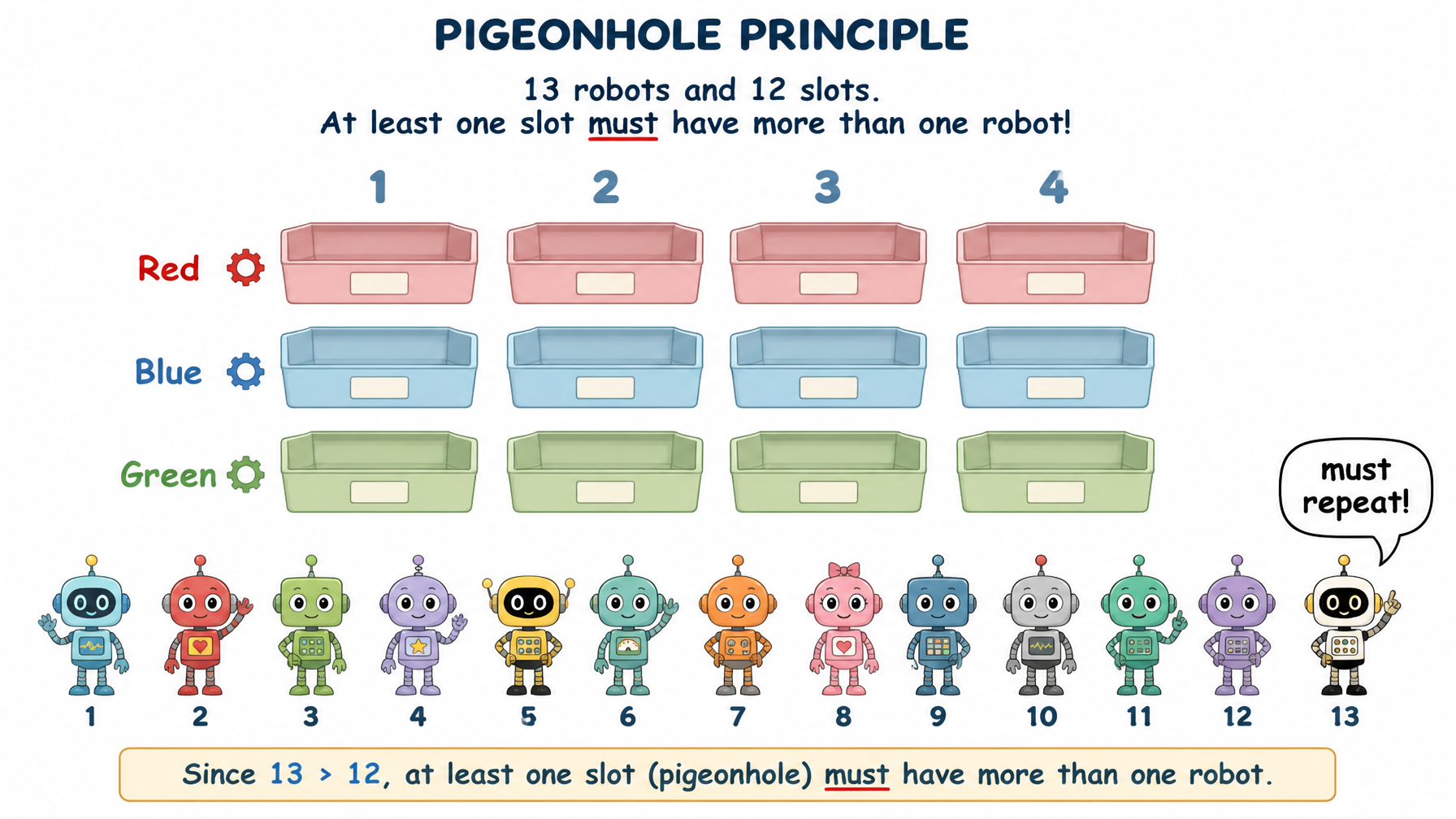
8.3 Pigeonhole principle — guaranteed collisions
Statement: If you put items into boxes, some box has at least 2 items.
More generally, if you put items into boxes, some box has at least items.
2024 Q18 — worked in full
The Gaussbot factory assembles robots. Each robot comes in one of three colours: red, blue, or green. Each robot also has a number stamped on its head: , , , or . The th robot assembled is the first robot to have the same colour and the same number as a previously assembled robot. What is the greatest possible value of ?
Reframe: a robot is a (colour, number) pair. There are distinct pairs.
If you want the th robot to be the first repeat, then robots must all be different. That's at most different pairs. So , i.e. .
The greatest is therefore . Answer (C). ✅
🔑 Pigeonhole flavor: when a problem asks "the first time something is forced to happen" or "how many do I need to guarantee …", count distinct slots and add 1.
Other pigeonhole flavors
- "In any group of people, at least two share a birth month." — items, months → some month has .
- "A drawer has red, blue, green socks. How many do you need to grab to guarantee a pair?" — colors → socks guarantee.
8.4 Casework discipline — disjoint and complete
The two failure modes of casework:
- Overcounting — the cases overlap, so something gets counted twice
- Undercounting — the cases don't cover everything
Antidote: define the cases by a single splitting variable, and check the cases are disjoint and their union is everything.
2024 Q24 — Tiny three-digit integers
A three-digit integer is called Tiny if no rearrangement of its digits gives a three-digit integer that is smaller. For example, are Tiny but are not. How many three-digit integers are Tiny?
Reframe: is Tiny iff is the smallest 3-digit integer among the rearrangements of its digits .
A 3-digit integer must have a non-zero leading digit. The smallest rearrangement of digits (with the constraint that the leading digit ≠ 0) is what we want our number to equal.
Split into cases by how many of are :
Case 1 — No zeros (). The smallest rearrangement is the digits in non-decreasing order. So Tiny has , all in –.
Count: the number of non-decreasing triples from . This is the "stars and bars" count: . (Or: enumerate by — for each , count pairs with .)
Case 2 — Exactly one zero. WLOG the digits are with . The smallest 3-digit rearrangement is (since the leading digit can't be , so we put the smallest nonzero first, then the , then the rest in order). For our number to BE this smallest, we need , i.e. — contradicting that one digit was . Wait — the digits are unordered but in the puzzle name the positions. Re-read: our number is , its digits are some multiset , and we ask whether equals the smallest 3-digit rearrangement.
Reframing: pick the digit multiset, find the smallest 3-digit arrangement, and that arrangement is the unique Tiny number for this multiset. So we just count multisets (with non-zero leading possible).
Count of multisets of size 3 from with at least one non-zero:
Total multisets of 3 digits from 0–9: .
Subtract the one "all zeros" multiset: .
Answer (E) 219. ✅
🔑 The win: by reframing "Tiny" as "is the smallest arrangement of its digit multiset", every digit multiset gives exactly one Tiny number. So count multisets, not numbers.
⚠️ Trap (the wrong answer (A) 255): students who count ordered with AND allow get a different count. Always check: is the leading digit allowed to be ?
8.5 Tree counting (multi-stage)
When choices are sequential and constrained by earlier choices, draw a tree (or imagine one) and multiply along a branch, add across branches.
Example — 4-letter words from {A, B, C} with no two adjacent letters equal
- Position 1: choices
- Position 2: choices (any letter except position 1's)
- Position 3: choices
- Position 4: choices
Total: .
Tree shape: branches branch out from each position, and we multiply.
8.6 Trap Alerts ⚠️
- Leading zero — a "3-digit integer" cannot start with . Always check whether your enumeration accidentally includes "" etc.
- "Different" / "distinct" — when the problem says different digits or different integers, no repetition is allowed. Easy to miss.
- Pigeonhole gives "at least 2", NOT "exactly 2". If you only need to collide, pigeonhole works; if you need , use form.
- Casework overlap — cases like "contains a 7" and "contains an even digit" overlap on numbers like 76. Use disjoint splits like "contains exactly one 7", "contains exactly two 7s", "contains three 7s".
- The complement of "at least one" is "none", not "exactly one".
8.7 Mnemonic
"Enumerate in order, complement when stuck, pigeonhole for guarantees, split into disjoint cases."
- In order: lexicographic, or by leading digit, or by smallest element
- Complement: if "at least one X", count "no X" and subtract
- Pigeonhole: items in boxes → repeat guaranteed
- Disjoint cases: split by a single attribute, check union = everything
Practice Set (10 problems, mixed difficulty)
- (Part A) How many 2-digit numbers contain the digit ?
- (Part A) From the set , how many ways are there to pick a pair that sums to ?
- (Part B) How many 3-digit numbers have all distinct digits?
- (Part B) In a class of students, at least how many share a birth month?
- (Part B) A coin is flipped 4 times. How many outcomes have at least one heads?
- (Part B) A 4-digit number has digits summing to (allowing zeros except leading). How many such numbers?
- (Part C) How many integers from to are divisible by neither nor ?
- (Part C) In how many ways can people be arranged in a row if two of them refuse to stand next to each other?
- (Part C) A bag has red balls and blue balls. How many ways are there to draw balls so that at least one is red?
- (Part C) How many 4-digit "palindromes" (read same forwards and backwards) are divisible by ?
Answers: 1) 18 (); 2) 4 (); 3) ; 4) 3 (, so some month has ); 5) ; 6) leading-zero correction = … direct: pairs with , sum 5 → 31; 7) ; 8) ; 9) Total , no red , so ; 10) palindrome , divisible by 11 iff , always true; count: , → .
End of chapter. Next: Probability, Mean, Median & Range.