Chapter 6 — Taylor & Maclaurin Series
By the end of this chapter you will:
- Derive the Taylor coefficient formula
- Write the Taylor / Maclaurin series of a function
- Use Taylor polynomials (partial sums) for numerical estimation
- Understand why the coefficients take exactly that form
6.1 Motivation — Approximating Functions with Polynomials
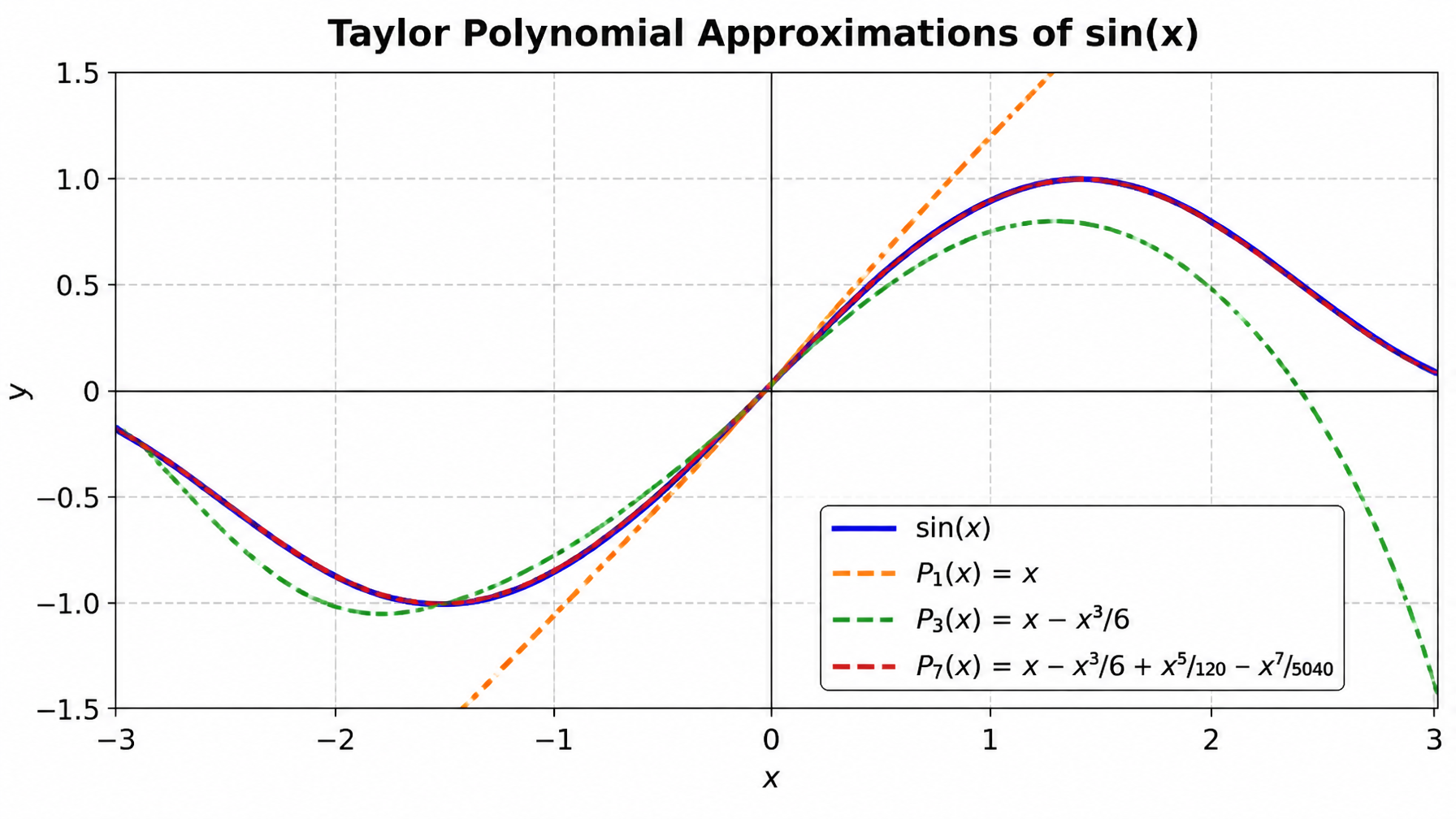
Problem: can a polynomial approximate a complicated function — and grow more accurate with more terms?
Why we care: polynomials are easy to compute (just add, subtract, multiply). , , are not. Approximation lets us replace difficult functions with quick polynomial computations.
Taylor's idea: force the polynomial and to agree on all derivatives at a chosen point . The two then track each other very closely near .
🎵 Audio 1 — Why polynomial approximation? — audio/ch6_01_motivation.mp3
6.2 Deriving the Taylor Coefficients
Suppose
Set :
Differentiate both sides:
Set : .
Differentiate again:
Set : .
After differentiations and setting :
🎵 Audio 2 — Coefficient derivation — audio/ch6_02_derivation.mp3
6.3 Definitions
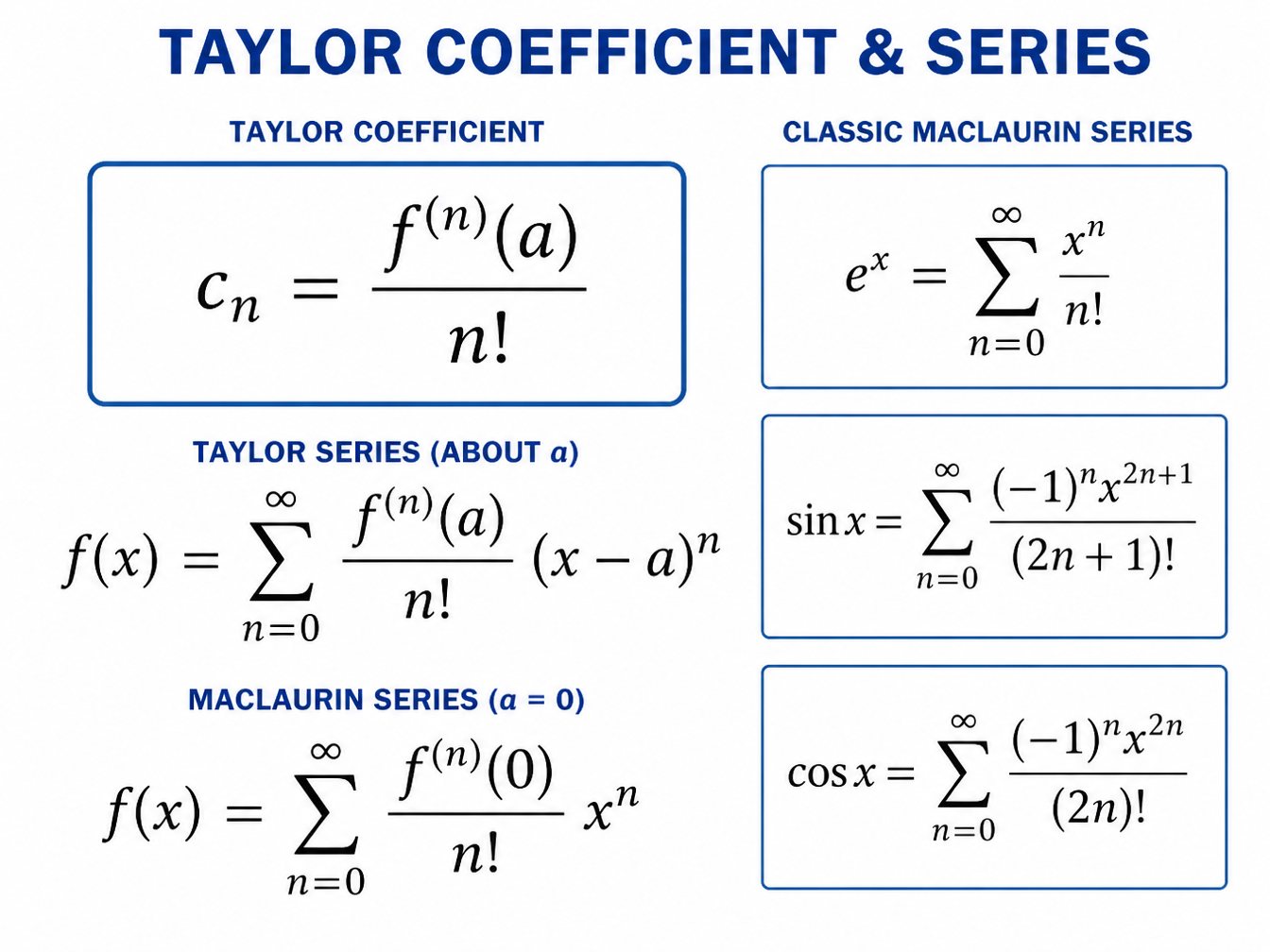
Taylor series of centered at :
Taylor polynomial of degree (partial sum):
Maclaurin series: a Taylor series centered at :
🔑 Caution: a Taylor series can converge but not to . Equality requires the Lagrange remainder to vanish (Chapter 8).
🎵 Audio 3 — Taylor / Maclaurin definitions — audio/ch6_03_definitions.mp3
6.4 Maclaurin Series from the Definition
Example 1:
All derivatives equal , so .
Radius of convergence (verified in Ch. 7).
Example 2:
Derivatives cycle with period 4: .
At :
Only odd-order coefficients survive, and signs alternate:
Example 3:
Cycle: . At 0: .
🎵 Audio 4 — Three classics: , , — audio/ch6_04_three_classics.mp3
6.5 Expanding About
Find the Taylor series of at .
, so , so , so .
In general for .
🔑 Strategy: compute the first 3–4 derivatives until you spot the pattern, then write the closed form.
6.6 Numerical Estimation with Taylor Polynomials
Example
Estimate using the 4th-degree Maclaurin polynomial.
(Note: has zero even-order coefficients, so degree 4 is effectively the cubic.)
.
True value , error . ✅
🎵 Audio 5 — Numerical estimation — audio/ch6_05_approximation.mp3
6.7 Trap Alerts ⚠️
- Don't drop the in the coefficient .
- "Degree- Taylor polynomial" means the highest power is — but functions like may have zero coefficients on even powers.
- Convergence ≠ equality with . You need the Lagrange remainder to vanish.
- The center is not always 0. AP loves or .
- First few derivatives are easy to miscompute — slow down on the first 3–4, then generalize.
6.8 Mnemonic
"Function = polynomial sum, coefficients are "
- Maclaurin = Taylor at
- Memorize three classics: , ,
- Compute first 3–4 derivatives, then generalize
🎵 Audio 6 — Recap + mnemonic — audio/ch6_06_recap.mp3
Media Inventory
| File | Purpose |
|---|---|
| audio/ch6_01_motivation.mp3 | Why approximate? |
| audio/ch6_02_derivation.mp3 | Coefficient derivation |
| audio/ch6_03_definitions.mp3 | Taylor / Maclaurin |
| audio/ch6_04_three_classics.mp3 | , , |
| audio/ch6_05_approximation.mp3 | Estimation |
| audio/ch6_06_recap.mp3 | Recap |
| images/ch6_approximation.png | Polynomial vs. |
| images/ch6_formula.png | Coefficient summary |
End of chapter. Next: common Maclaurin expansions and operations.