Chapter 5 — Power Series, Radius & Interval of Convergence
By the end of this chapter you will:
- Write a power series in standard form
- Use the ratio test to find the radius of convergence
- Test endpoints to determine the full interval of convergence
- Handle every standard AP power-series question
5.1 What is a Power Series?
A series whose terms are powers of a variable :
- — the center
- — the coefficients
- — the variable
- When we say "power series about 0", written
🎵 Audio 1 — Definition — audio/ch5_01_intro.mp3
The fundamental question
A power series is a family of series — one for each . The same series can converge for some and diverge for others. So the central question is:
"For which does the series converge?"
The answer is always an interval , centered at , with width determined by the radius of convergence .
5.2 The Radius of Convergence Theorem
Theorem: every power series falls into exactly one of three cases:
- Converges only at ()
- Converges for all ()
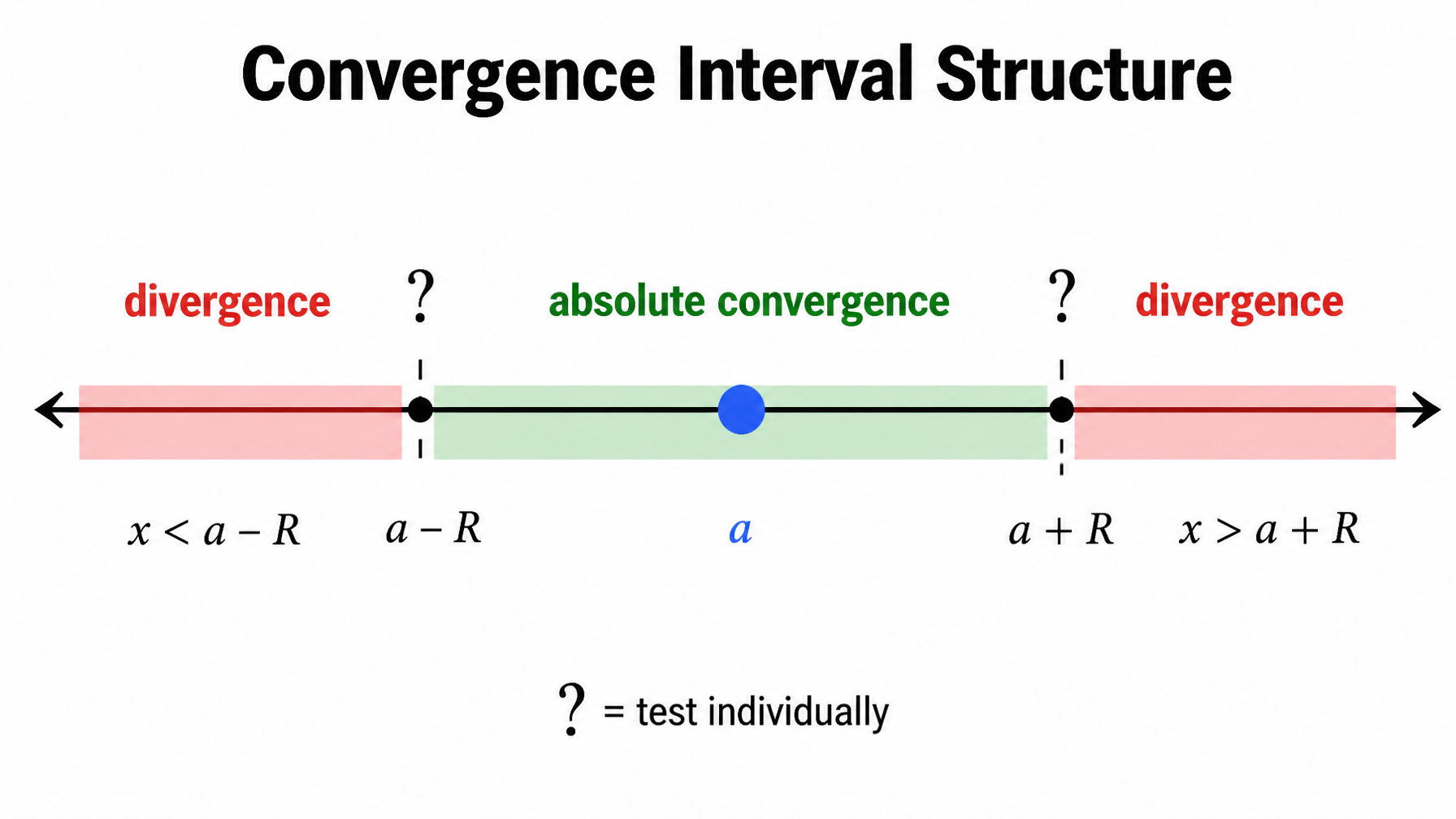
- There is some : absolute convergence for , divergence for , and the endpoints must be tested individually.
🔑 Insight: the interior is determined by . The endpoints take separate work — and that's where most AP exam points are won or lost.
🎵 Audio 2 — Three-case theorem — audio/ch5_02_radius.mp3
5.3 Finding via the Ratio Test
For :
Let (when it exists).
Convergence requires :
So (; ).
🎵 Audio 3 — Ratio test for — audio/ch5_03_ratio_method.mp3
Example 1
.
. Center , interior .
Example 2 ()
.
Holds for every , so . (This is the Maclaurin series of .)
Example 3 ()
.
So , the series converges only at .
5.4 Endpoint Testing — Where AP Points Are Won
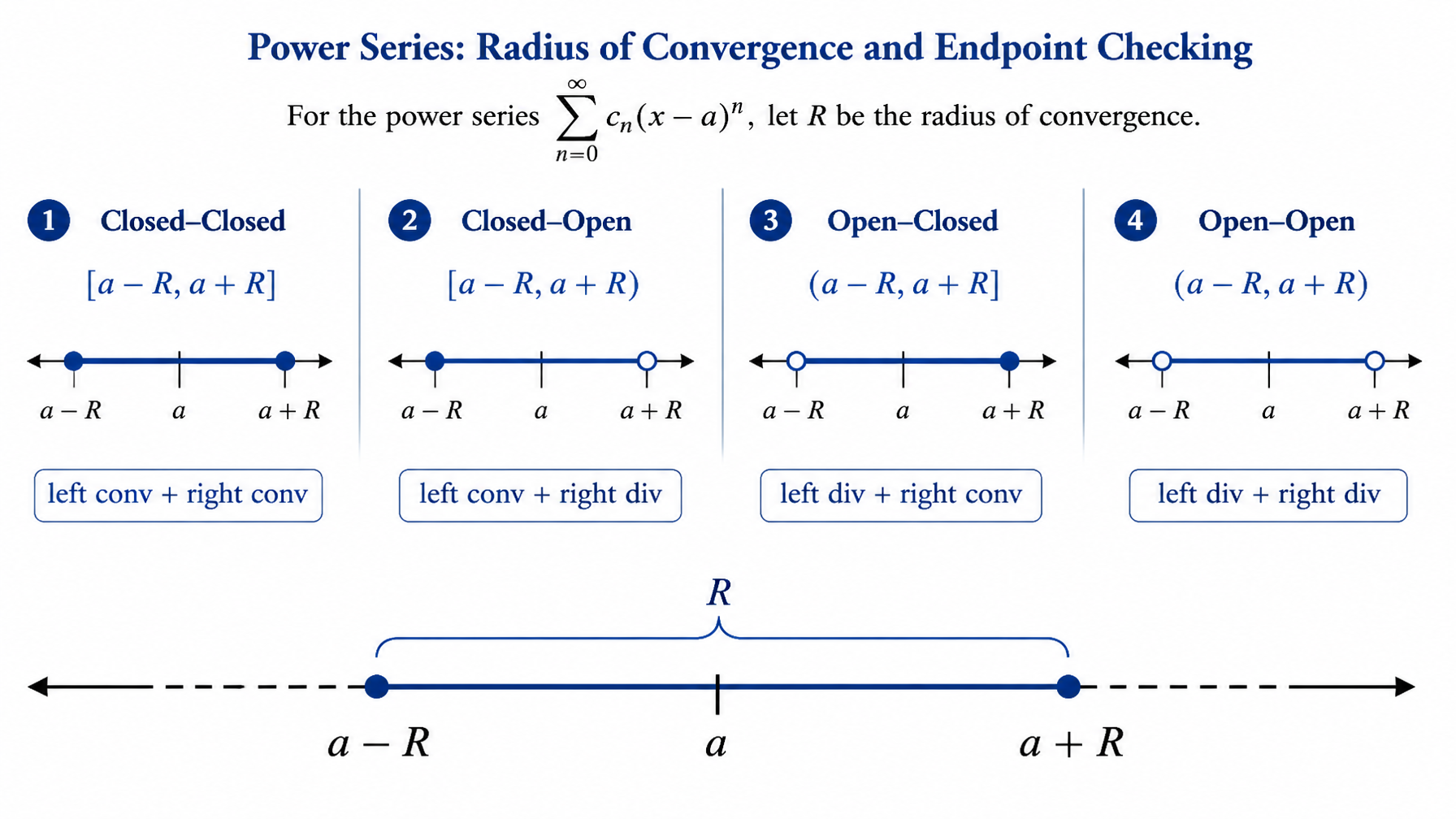
After you find , the interior is . The endpoints and must be plugged in and analyzed individually.
There are 4 possible outcomes:
| Left | Right | Interval |
|---|---|---|
| converges | converges | closed-closed |
| converges | diverges | closed-open |
| diverges | converges | open-closed |
| diverges | diverges | open-open |
🎵 Audio 4 — Why endpoints matter — audio/ch5_04_endpoints.mp3
Full worked example
Find the interval of convergence of .
Step 1 — find :
. Interior .
Step 2 — left endpoint :
Alternating harmonic — converges by AST. ✓
Step 3 — right endpoint :
Harmonic — diverges. ✗
Conclusion: interval of convergence is .
🔑 Strategy: after substitution, endpoints typically reduce to a p-series, geometric series, or alternating series — apply the standard tests from chapters 2–4.
5.5 Convergence-Interval Structure (memorize this picture)
        diverges            converges            diverges
   ←———————|—————————————————————|———————→
        a - R        a            a + R
       (endpoint)  (center)     (endpoint)
- Interior : absolute convergence
- Endpoints : test individually
- Outside : divergence
🎵 Audio 5 — Interval structure — audio/ch5_05_structure.mp3
5.6 Mixed Examples (AP-style)
Find the interval of convergence:
(a)
(b)
Solution (a):
. , , interior .
Endpoint : converges by comparison with .
Endpoint : — absolutely convergent.
Interval: .
Solution (b):
. , interior .
Endpoint : — conditionally convergent (AST).
Endpoint : — diverges ().
Interval: .
🎵 Audio 6 — Worked examples — audio/ch5_06_examples.mp3
5.7 Trap Alerts ⚠️
- Skipping endpoint checks is the #1 way AP students lose points on power-series free-response.
- The center isn't always 0. Solve correctly.
- Bracket vs. parenthesis: closed at converging endpoints, open at diverging ones.
- : the interval is — no endpoints.
- : the interval collapses to the single point — write it as a set.
🎵 Audio 7 — Traps + recap — audio/ch5_07_traps_recap.mp3
5.8 Mnemonic
"Ratio for R; test both endpoints; brackets follow convergence."
- Ratio test:
- Test both endpoints by substitution
- Use for converging endpoints, for diverging ones
Media Inventory
| File | Purpose |
|---|---|
| audio/ch5_01_intro.mp3 | Power-series definition |
| audio/ch5_02_radius.mp3 | Three-case theorem |
| audio/ch5_03_ratio_method.mp3 | Ratio test for |
| audio/ch5_04_endpoints.mp3 | Endpoint analysis |
| audio/ch5_05_structure.mp3 | Interval structure |
| audio/ch5_06_examples.mp3 | Mixed examples |
| audio/ch5_07_traps_recap.mp3 | Traps + recap |
| images/ch5_interval.png | Interval diagram |
| images/ch5_radius.png | Endpoint scenarios |
End of chapter. Next: Taylor and Maclaurin series.