Chapter 4 — Alternating Series, Absolute & Conditional Convergence
By the end of this chapter you will:
- Apply the Alternating Series Test (AST)
- Distinguish absolute vs. conditional convergence
- Estimate the truncation error of an alternating series
- Handle every AP question that combines AST with error bounds
4.1 What is an Alternating Series?
A series whose terms alternate sign:
or
Canonical example: — the alternating harmonic series, which converges to .
🎵 Audio 1 — What is an alternating series? — audio/ch4_01_intro.mp3
4.2 Alternating Series Test (AST)
Two hypotheses required:
- is monotonically decreasing (i.e. for sufficiently large )
Conclusion: converges.
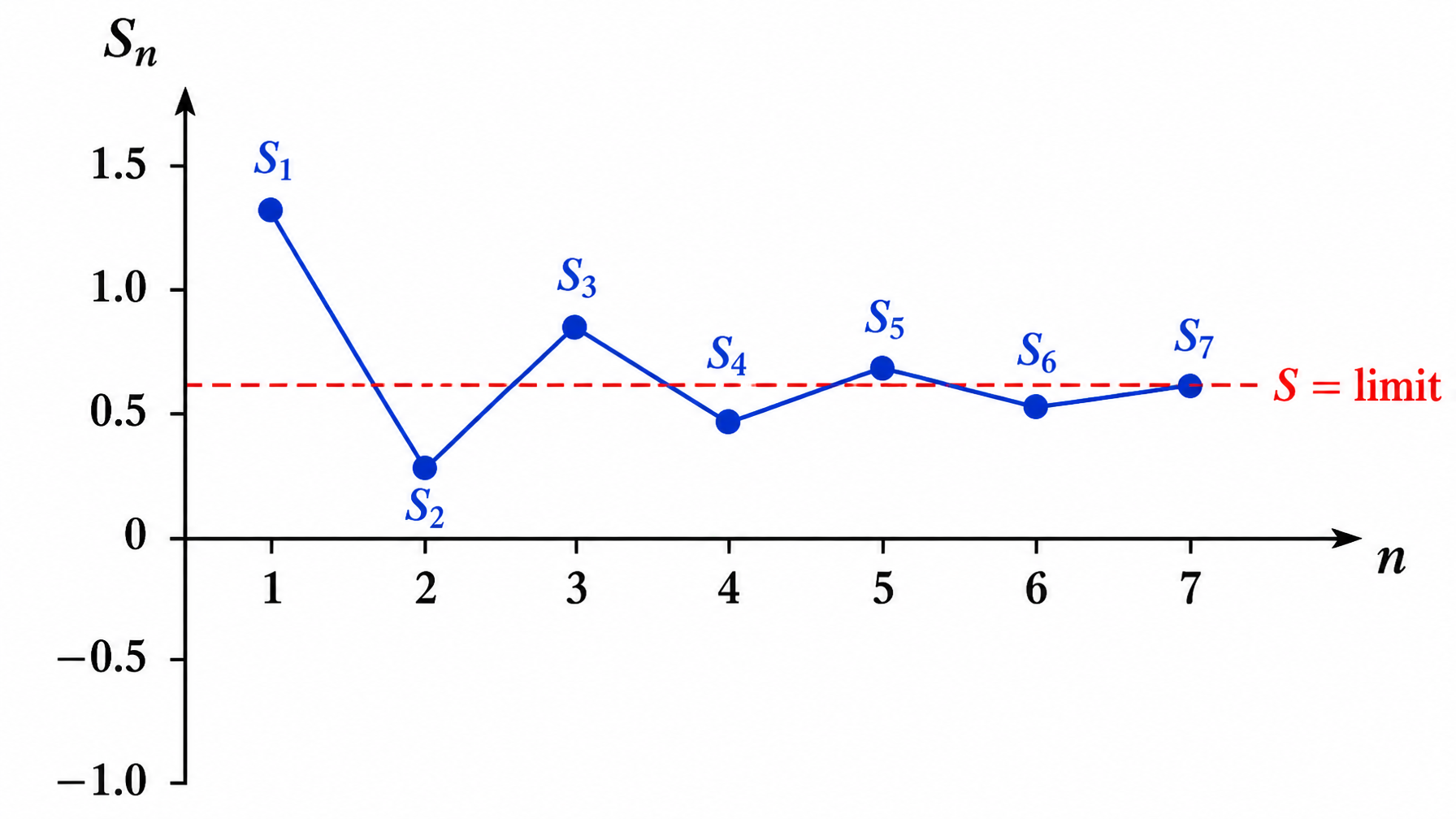
Intuition — pendulum: the partial sums oscillate around the limit with decreasing amplitude. As the swing shrinks to 0, the pendulum must settle at a single point.
🎵 Audio 2 — AST hypotheses + pendulum analogy — audio/ch4_02_ast.mp3
Example 1 — alternating harmonic
.
- is monotonically decreasing ✓
- ✓
By AST, converges (sum ).
Example 2
.
- . Check monotonicity via , for . ✓
- . ✓
Converges.
⚠️ Trap: many students forget to check monotonicity. If but is not eventually decreasing, AST does not apply.
🔑 Three ways to verify monotonicity: derivative sign, ratio vs. 1, or rewrite as a known monotone function.
4.3 Absolute vs. Conditional Convergence
For a series (mixed signs allowed):
| Term | Definition |
|---|---|
| Absolutely convergent | converges |
| Conditionally convergent | converges but diverges |
| Divergent | does not converge |
🎵 Audio 3 — Absolute vs. conditional — audio/ch4_03_abs_cond.mp3
Key relationship
The converse is false — conditional convergence exists.
Comparison table
| Series | Type | ||
|---|---|---|---|
| converges (AST) | diverges (harmonic) | Conditional | |
| converges (AST) | converges () | Absolute | |
| diverges (term limit) | diverges | Divergent |
🔑 Workflow:
- First test the absolute version using Chapter 3 tools.
- If it converges → absolutely convergent, done.
- If it diverges → check via AST. AST passes → conditional. AST fails → divergent.
🎵 Audio 4 — Three-step workflow — audio/ch4_04_workflow.mp3
4.4 Alternating Series Estimation Theorem (AST Error Bound)
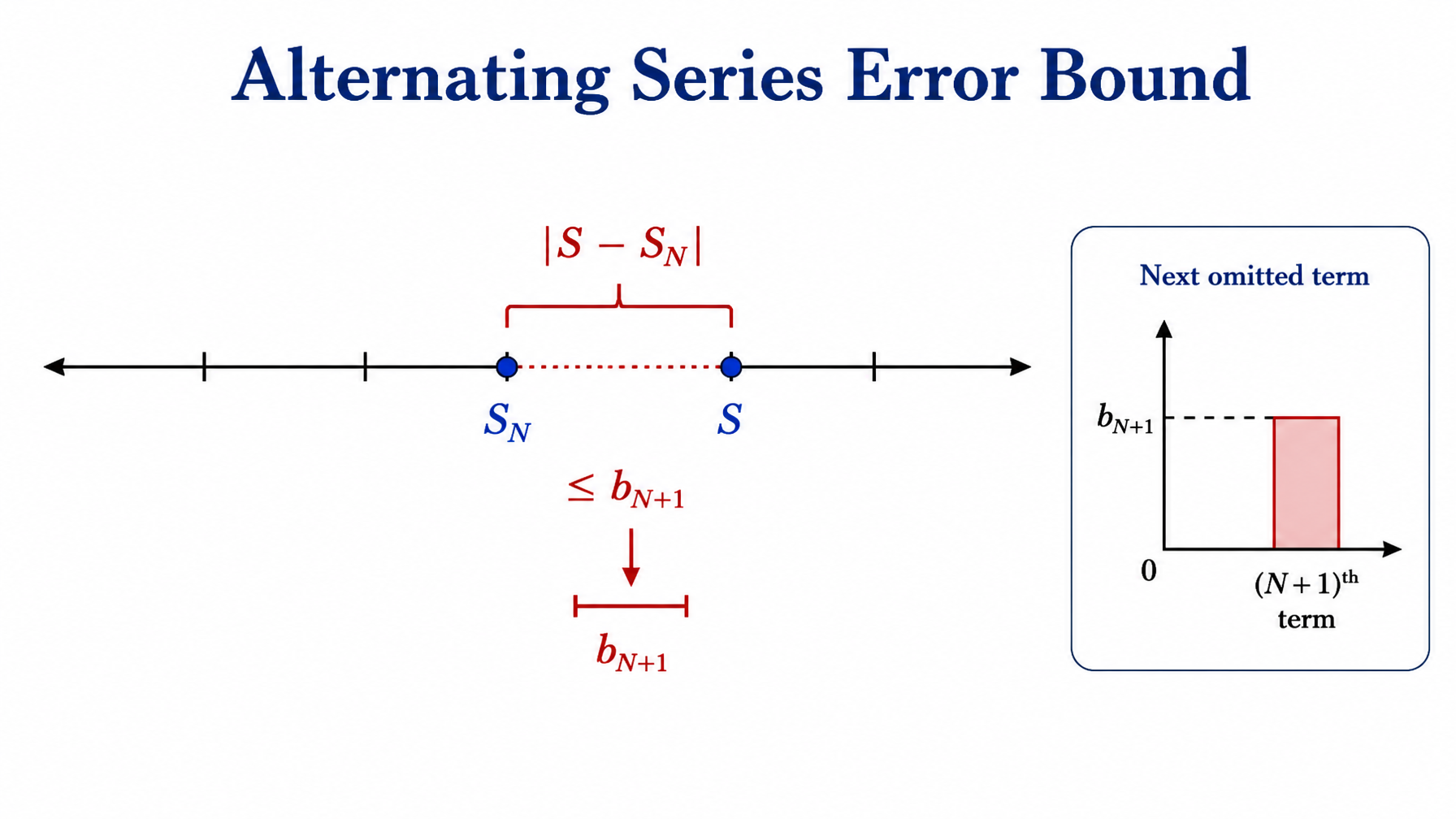
Theorem: if satisfies AST with sum and partial sum , then
In words: when you truncate an alternating series after terms, the truncation error is bounded by the first term you didn't add.
Intuition: the next pendulum swing is the maximum distance from the current position to the limit.
🎵 Audio 5 — AST error bound + worked example — audio/ch4_05_error_bound.mp3
Example (AP-style)
Estimate with the first 3 terms; bound the error.
Partial sum:
Error:
🔑 Inverse problem: "How many terms do I need so the error is below ?" → solve .
Inverse example
How many terms of are needed so the partial-sum error is below ?
Solve .
You need at least 10 terms.
4.5 Mixed Examples
Decide convergence; if convergent state absolute or conditional.
(a)
(b)
(c)
Solutions:
(a) Absolute version is a series → diverges. AST: decreases to 0 → converges. Conditionally convergent.
(b) Absolute version converges by comparison with → absolutely convergent.
(c) Term limit doesn't go to 0 (oscillates between ) → divergent by n-th term test.
🎵 Audio 6 — Walkthrough of (a)–(c) + recap — audio/ch4_06_examples_recap.mp3
4.6 Trap Alerts ⚠️
- AST requires monotonicity. alone is not enough.
- Test absolute convergence first. Skipping this on AP costs partial credit.
- Error bound is , the first omitted term — a common off-by-one trap.
- Brackets: always lies between and (oscillating-pendulum visualization).
- alone diverges — don't even try AST.
4.7 Mnemonic
"Test the absolute first; AST needs monotonic decrease; error is the next term."
- Absolute first: handle via Chapter 3 tools
- AST: monotonic decreasing and
- Error:
Media Inventory
| File | Purpose |
|---|---|
| audio/ch4_01_intro.mp3 | What is an alternating series? |
| audio/ch4_02_ast.mp3 | AST hypotheses + pendulum |
| audio/ch4_03_abs_cond.mp3 | Absolute vs. conditional |
| audio/ch4_04_workflow.mp3 | Three-step workflow |
| audio/ch4_05_error_bound.mp3 | AST error bound |
| audio/ch4_06_examples_recap.mp3 | Examples + recap |
| images/ch4_alternating.png | Pendulum convergence |
| images/ch4_error_bound.png | Error bracketed by next term |
End of chapter. Next: power series, radius and interval of convergence.