Chapter 3 — The Convergence-Test Toolkit
Why this chapter matters: this is the heart of BC series. Roughly 80% of AP convergence problems boil down to "pick the right test from this menu." Practice until you can identify the right test from a one-second glance at the general term.
By the end of this chapter you will:
- Master 7 major tests (n-th term, integral, p-series, comparison, limit comparison, ratio, root)
- Use a decision tree to pick a test
- Handle every standard AP convergence question
3.1 The Decision Tree — Spirit of the Chapter
Given a series , ask these questions in order:
Look at a_n
│
├─ lim a_n ≠ 0? → Divergent (n-th term test, §3.2)
│
├─ Form a·r^n? → Geometric series (Ch 2)
│
├─ Form ^p? → p-series (Ch 2)
│
├─ Has (-1)^n alternation? → Alternating Series Test (Ch 4)
│
├─ Has n!, r^n, or n^n? → Ratio test or Root test (§3.6, 3.7)
│
├─ a_n = f(n) with f → Integral test (§3.3)
│ positive & decreasing?
│
├─ Looks like a known → Comparison or Limit Comparison (§3.4, 3.5)
│ conv/div series?
│
└─ None of the above? → Try telescoping (Ch 2.5)
🔑 Meta-rule: scan the shape of . Factorials/exponentials → ratio/root. Rational expressions → comparison/limit comparison. Logs/trig → integral test.
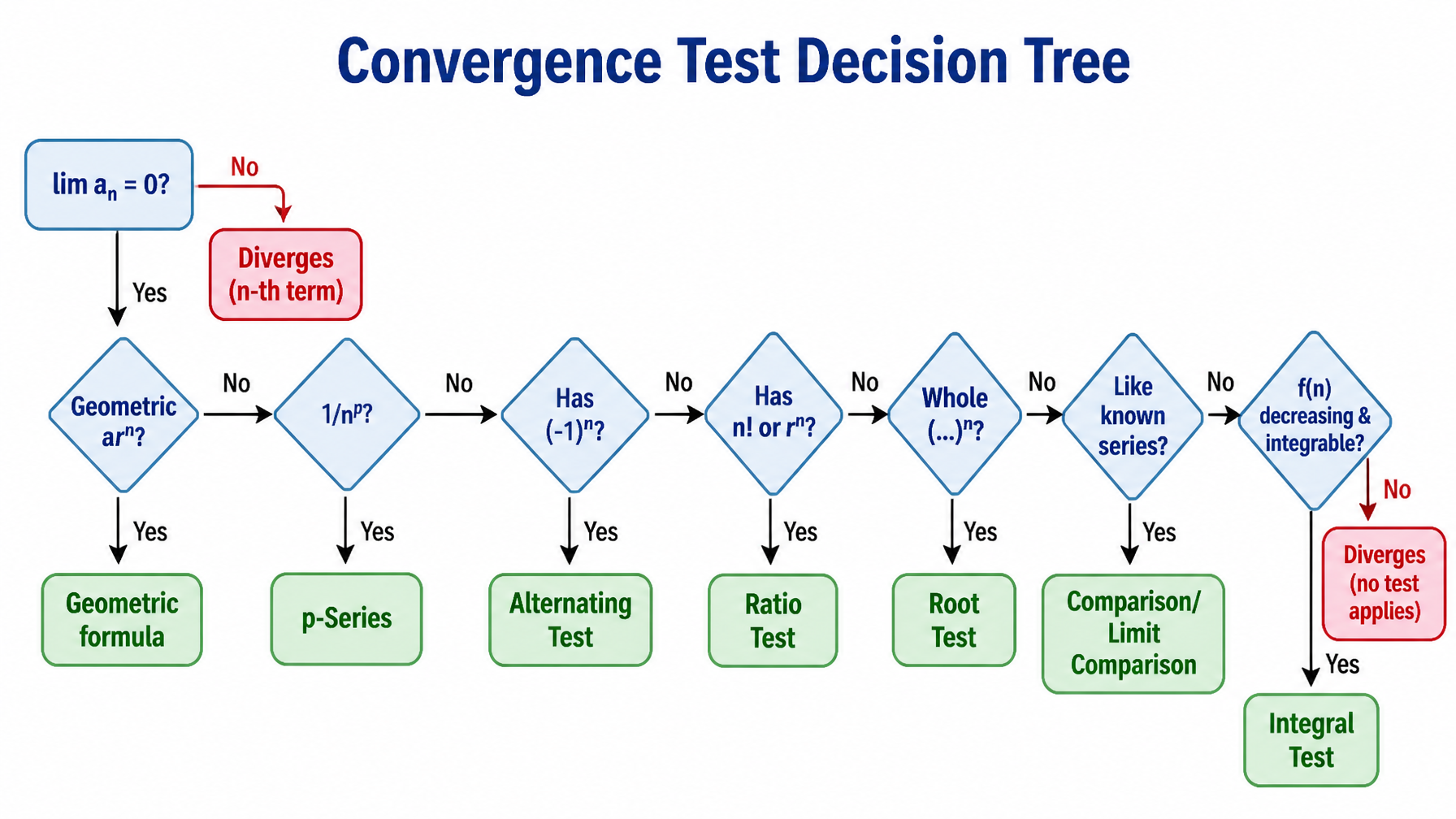
🎵 Audio 1 — Decision-tree overview — audio/ch3_01_decision_tree.mp3
3.2 n-th Term Test (review)
If , then diverges. The converse is false.
Already covered in §2.4. Use as your first filter.
3.3 Integral Test
Hypotheses (all three required):
- where is positive, continuous, and monotonically decreasing on
Conclusion:
Intuition: integrals are the continuous analog of sums. Picture rectangles of width 1 and height ; monotone decrease ensures the rectangles' total area is sandwiched between and .
🎵 Audio 2 — Integral test — audio/ch3_02_integral.mp3
Example
Decide .
Step 1 — Verify hypotheses: is positive, continuous, decreasing on . ✓
Step 2 — Evaluate the integral:
Integral diverges → series diverges.
🔑 Strategy: when appears in the denominator, substitute .
⚠️ Trap: the integral test cannot give you the value of the sum. Only convergence/divergence. (For example, but .)
3.4 Direct Comparison Test (DCT)
Hypotheses: for all sufficiently large (i.e. positive-term series).
Conclusion:
- converges converges
- diverges diverges
Analogy: if your wallet contains less than a billionaire's, and the billionaire is finite, then so is yours. The reverse argument is for divergence.
🎵 Audio 3 — Direct comparison — audio/ch3_03_compare.mp3
Example
Decide .
Reasoning: , and converges (p-series, ). DCT → converges.
🔑 Strategy: pick a known yardstick — usually a geometric series or p-series.
⚠️ Trap: direction matters. To prove convergence you must dominate by a larger convergent series. To prove divergence you must be dominated below by a divergent series.
3.5 Limit Comparison Test (LCT)
Hypotheses: .
Test: compute .
Conclusion:
- → and agree (both converge or both diverge)
- and converges → converges
- and diverges → diverges
Why LCT often beats DCT: DCT requires a strict inequality you can prove; LCT only needs the same asymptotic order.
🎵 Audio 4 — Limit comparison — audio/ch3_04_limit_compare.mp3
Example
Decide .
Step 1 — Pick : leading-term analysis says . Let .
Step 2 — Compute the limit:
. ✓
Step 3: converges → original converges.
🔑 How to choose : keep only the dominant term. For rational expressions, match the highest-power ratio.
3.6 Ratio Test (a must when factorials or exponentials appear)
When to use: terms contain , , , etc.
Compute:
Conclusion:
- → absolutely convergent
- (including ) → divergent
- → inconclusive, switch to a different test
🎵 Audio 5 — Ratio test + factorial cancellation — audio/ch3_05_ratio.mp3
Example 1 (factorial classic)
Decide .
→ converges.
Example 2 (when fails)
Decide (we already know it diverges).
The test is inconclusive — use the integral test or the p-series rule instead.
🔑 Factorial cancellation: and .
⚠️ Trap: ratio test always gives on a p-series. Don't waste time — use the p-series rule directly.
3.7 Root Test
When to use: the entire general term is raised to the -th power, e.g. .
Compute:
Conclusion: identical to ratio test ( converges, diverges, inconclusive).
🎵 Audio 6 — Root test — audio/ch3_06_root.mp3
Example
Decide .
→ converges.
🔑 Ratio vs. root: an outer -th power cries out for the root test; factorials cry out for the ratio test.
3.8 Quick-Reference Table
| Shape of | Best test |
|---|---|
| Obvious | n-th term (rule out divergence first) |
| Geometric formula | |
| p-series rule | |
| Has or | Ratio |
| Outer | Root |
| pos./cont./decreasing, easy to integrate | Integral |
| Looks like a known conv/div series | Comparison or Limit comparison |
| Has alternation | AST (Ch 4) |
3.9 Mixed Examples
Decide convergence:
(a)
(b)
(c)
(d)
Solutions:
(a) Ratio test (because ):
Converges.
(b) Direct comparison or limit comparison: for large , , so . Or: limit-compare with , ratio . Converges.
(c) Integral test (because in the denominator):
Integral finite → converges.
(d) Limit comparison with : leading term is . Converges.
🎵 Audio 7 — Walkthrough of (a)–(d) — audio/ch3_07_examples.mp3
3.10 Trap Alerts ⚠️
- Don't push past in ratio/root — switch tests immediately.
- Comparison/LCT only work for positive-term series. Take absolute values first if signs are mixed.
- Integral test gives convergence, not the sum.
- DCT direction matters: dominate above for convergence, dominate below for divergence.
- LCT requires for the two-way conclusion. or gives a weaker one-way conclusion.
- Memorize p-series and geometric series: nearly every comparison rests on them.
🎵 Audio 8 — Trap roundup — audio/ch3_08_traps.mp3
3.11 30-Second Decision Algorithm
1. Does a_n → 0? No → diverges (done)
2. Geometric or p-series? → apply formula
3. Has (-1)^n? → jump to Ch 4
4. Has n! or r^n? → Ratio test
5. Outer (...)^n? → Root test
6. Looks like ^p or r^n? → Comparison or LCT
7. f(n) positive, decreasing, easily integrable? → Integral test
8. None of the above? → try telescoping
🎵 Audio 9 — 30-second algorithm — audio/ch3_09_algorithm.mp3
3.12 Standard Yardsticks (memorize)
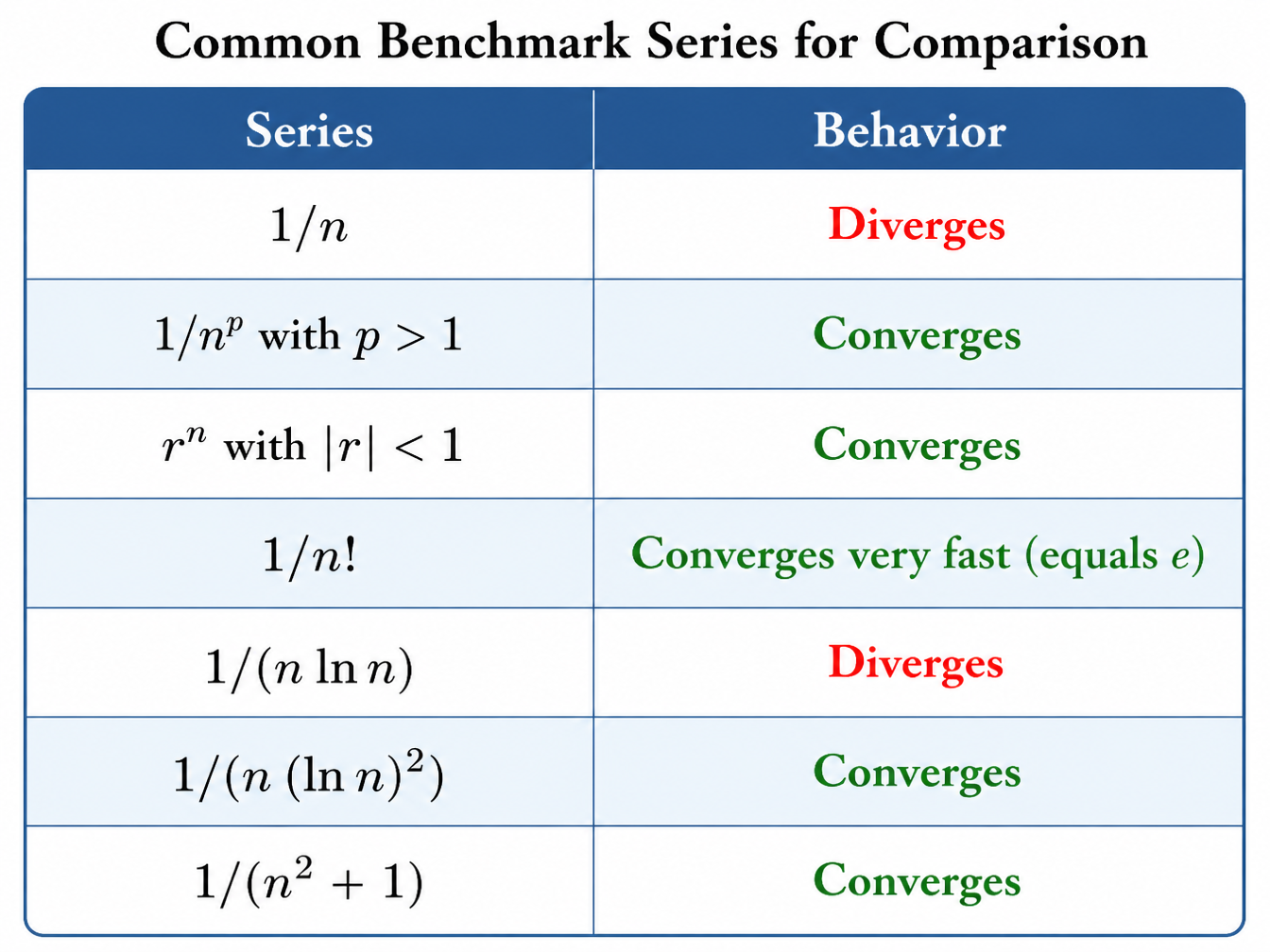
| Yardstick | Conv/Div |
|---|---|
| Diverges | |
| Converges | |
| Converges | |
| Converges fast (sum ) | |
| Diverges | |
| Converges | |
| Converges |
3.13 Mnemonic
"Recognize the shape, walk the decision tree."
- factorial / exponential → ratio
- outer -th power → root
- easy-to-integrate function → integral
- looks like p-series or geometric → comparison / LCT
- → switch tests immediately
- comparison only on positive terms
🎵 Audio 10 — Recap + mnemonic — audio/ch3_10_recap.mp3
Media Inventory
| File | Purpose |
|---|---|
| audio/ch3_01_decision_tree.mp3 | Decision-tree overview |
| audio/ch3_02_integral.mp3 | Integral test |
| audio/ch3_03_compare.mp3 | Direct comparison |
| audio/ch3_04_limit_compare.mp3 | Limit comparison |
| audio/ch3_05_ratio.mp3 | Ratio test |
| audio/ch3_06_root.mp3 | Root test |
| audio/ch3_07_examples.mp3 | Mixed examples |
| audio/ch3_08_traps.mp3 | Six traps |
| audio/ch3_09_algorithm.mp3 | 30-second algorithm |
| audio/ch3_10_recap.mp3 | Chapter recap |
| images/ch3_decision_tree.png | Decision flowchart |
| images/ch3_benchmarks.png | Yardstick reference |
End of chapter. Next: alternating series and absolute/conditional convergence.