Chapter 2 — Series Basics, Geometric Series, p-Series
By the end of this chapter you will:
- Define series convergence rigorously via partial sums
- Decide convergence of a geometric series and find its sum
- Decide convergence of a p-series
- Use the n-th term test as a one-look diverge-detector
- Handle telescoping series
2.1 What is a Series? — The Partial-Sum Idea
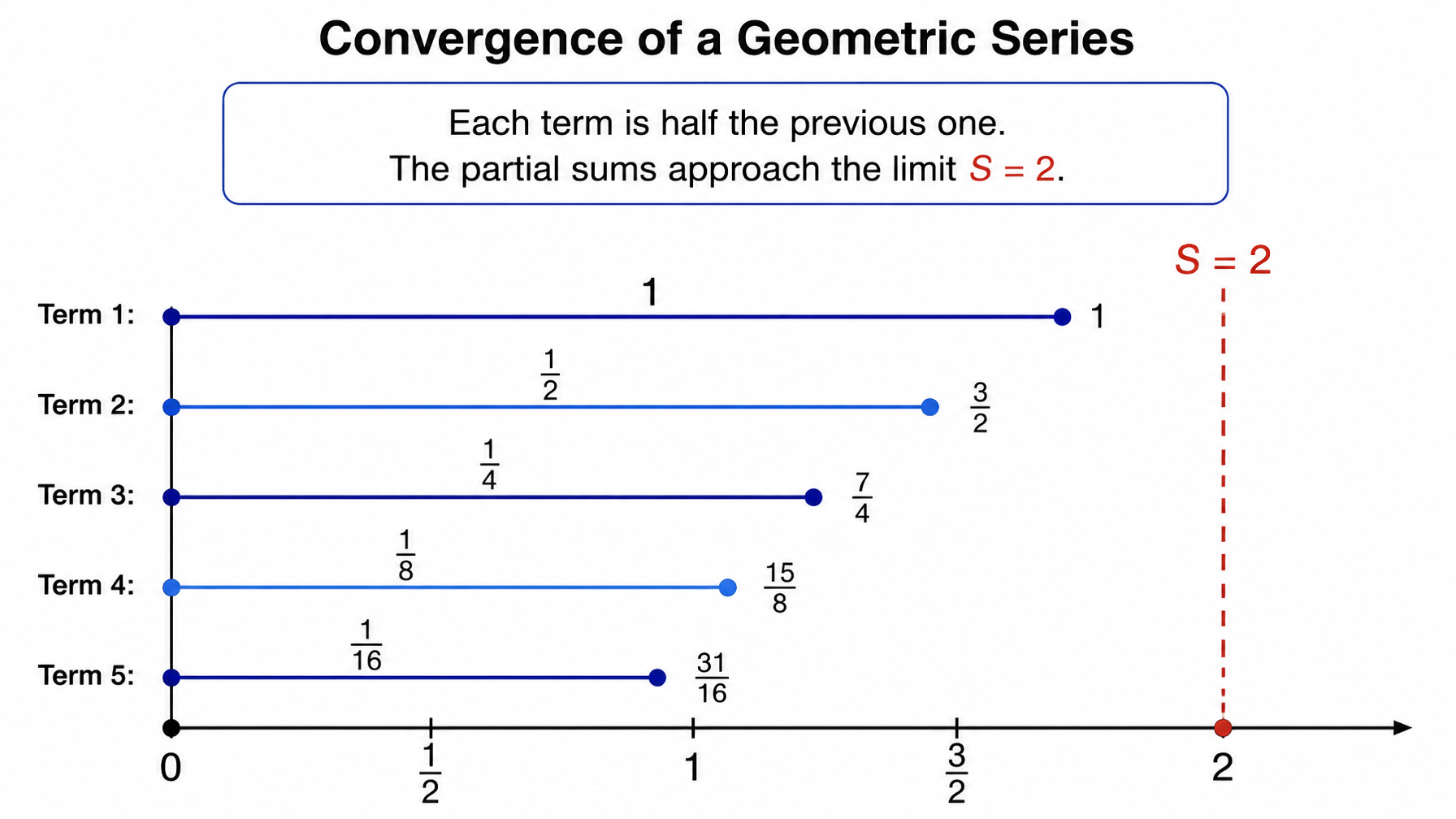
Picture this: you are slicing an apple. First slice takes half (), second takes half of what's left (), third takes half again ()…
Adding all the slices:
You sense the total approaches (because eventually the entire apple is sliced). That is what we mean by convergence of an infinite series.
Formal definition (the partial-sum approach):
So:
- Form the partial sum (this is a sequence).
- Check whether exists.
🔑 Key insight: a series is just the limit of a sequence of partial sums. Every tool from Chapter 1 carries over.
🎵 Audio 1 — Partial sums explained — audio/ch2_01_partial_sum.mp3
2.2 Geometric Series — A BC Must-Memorize
Form:
Here is the first term and is the common ratio.
Convergence test
| Condition | Conclusion |
|---|---|
| Converges to | |
| Diverges |
Derivation (you should know this)
Multiply both sides by :
Subtract:
When , , so .
🎵 Audio 2 — Geometric series formula and derivation — audio/ch2_02_geometric.mp3
Examples — Recognize and Sum
Example 1: .
Recognize: , . Since , converges. Sum .
Example 2: .
Rewrite to align indices:
First term () , . Sum .
🔑 Strategy: when is hidden, factor out coefficients and shift indices to match or .
⚠️ Trap: the starting index changes the first term . The same general term has when starting from but when starting from — sums differ by a factor of 2.
2.3 p-Series — The Second Must-Memorize
Form:
Convergence test
| Condition | Conclusion |
|---|---|
| Converges | |
| Diverges |
Three classics (memorize)
| Series | Conv/Div | Note | |
|---|---|---|---|
| 1 | Diverges | The "harmonic series" — counterintuitive | |
| 2 | Converges | Sum (Basel problem) | |
| 0.5 | Diverges |
🔑 Counterintuitive point: the harmonic series has terms going to 0, yet the sum diverges to infinity. So "terms tend to 0" does not guarantee convergence. The n-th term test only detects divergence — never convergence.
🎵 Audio 3 — p-series and the harmonic surprise — audio/ch2_03_pseries.mp3
Sketch of why
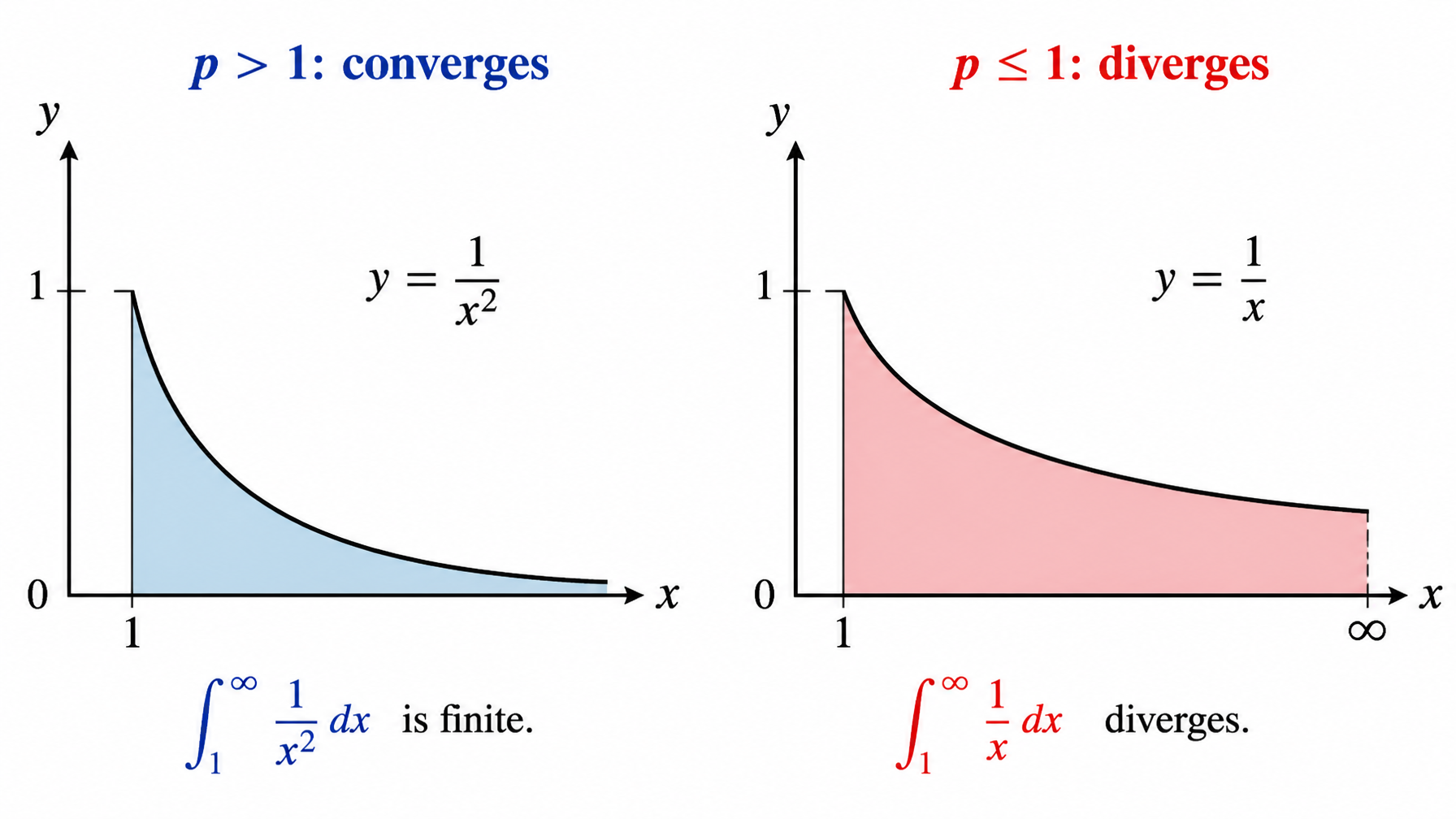
Compare the series with the integral . The integral converges precisely when , and the integral test (Chapter 3) makes this rigorous.
2.4 The n-th Term Test — One-Way Divergence Detector
Theorem: if (including non-existent), then diverges.
Intuition: to add infinitely many numbers and stop somewhere finite, the terms eventually have to shrink to 0. Otherwise you keep adding nonzero pieces, and the total flies off.
How to use it (notice the asymmetry!)
🔑 One-way theorem:
- series diverges ✅ (usable)
- series may or may not converge ❌ (no conclusion)
The harmonic series is the canonical reminder: terms yet diverges.
Examples
Example 1: .
Term limit , so diverges. ✅
Example 2: .
oscillates between , no limit, so diverges. ✅
🎵 Audio 4 — One-way nature of the n-th term test — audio/ch2_04_nthterm.mp3
2.5 Telescoping Series
A telescoping series is one whose general term splits as (or some other adjacent-cancellation form).
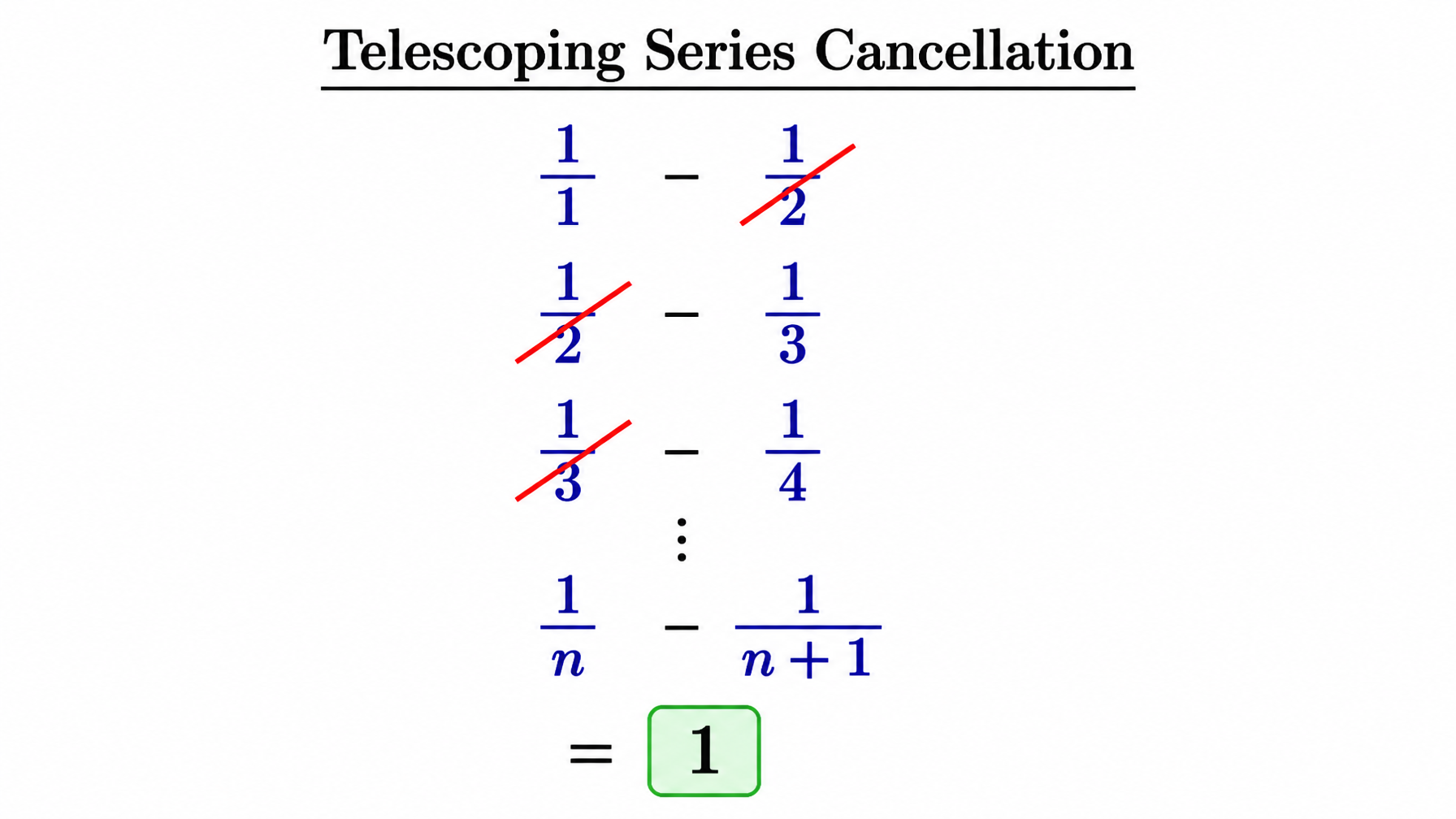
Signature: when you write the partial sum, almost every term cancels with the next, leaving just a head and tail.
Example
Find .
Step 1 — Partial fraction split:
Step 2 — Write the partial sum:
Almost everything cancels:
Step 3 — Take the limit:
So the series converges to 1. ✅
🎵 Audio 5 — Telescoping pattern — audio/ch2_05_telescoping.mp3
🔑 Recognition cues: terms involving , , or — try splitting.
2.6 Mixed Examples (AP-Style)
Decide convergence; find the sum if it converges.
(a)
(b)
(c)
(d)
Solutions:
(a) Geometric with , converges. Sum .
(b) p-series with , converges. (AP usually only asks for the verdict.)
(c) Term limit , n-th term test → diverges.
(d) Telescoping: .
Partial sum:
Surviving terms: . ✅
🎵 Audio 6 — Walkthrough of (a)–(d) — audio/ch2_06_examples.mp3
2.7 Trap Alerts ⚠️
- The n-th term test only detects divergence — never convergence. When you must move on to other tests.
- A geometric series's first term depends on the starting index. vs. .
- diverges. This is one of the most-tested counterintuitive facts in BC.
- Don't mis-cancel a telescoping sum. Always expand the first few terms and the last few terms before jumping to the limit.
- in a geometric series → diverges, regardless of sign.
2.8 Mnemonic
"Geometric → check ; p-series → compare with 1; term limit → divergence (one way); telescoping → split and cancel."
Media Inventory
| File | Purpose |
|---|---|
| audio/ch2_01_partial_sum.mp3 | Partial sum definition |
| audio/ch2_02_geometric.mp3 | Geometric series + derivation |
| audio/ch2_03_pseries.mp3 | p-series + harmonic surprise |
| audio/ch2_04_nthterm.mp3 | n-th term test (one-way) |
| audio/ch2_05_telescoping.mp3 | Telescoping pattern |
| audio/ch2_06_examples.mp3 | Mixed examples |
| audio/ch2_07_recap.mp3 | Recap + mnemonic |
| images/ch2_geometric.png | Geometric series visualization |
| images/ch2_telescoping.png | Telescoping cancellation |
| images/ch2_pseries.png | p-series convergence vs. divergence |
🎵 Audio 7 — Chapter recap — audio/ch2_07_recap.mp3
End of chapter. Next: the full toolkit of convergence tests.