Chapter 1 — Sequences
By the end of this chapter you will:
- Distinguish a sequence from a series
- Decide whether a sequence converges and find its limit
- Use the Monotonic Bounded Theorem (MBT) to prove convergence
- Recognize the standard sequence patterns AP loves to test
1.0 Sequence vs. Series — One-Line Distinction
| Sequence | Series | |
|---|---|---|
| What it is | A list of numbers | The sum of those numbers |
| Notation | or | |
| Convergence means | Term approaches a number | Total sum approaches a number |
| Analogy | A trail of footprints | The total length of the trail |
🔑 Key insight: A sequence converging does not imply the corresponding series converges. Example: converges to 0, but the harmonic series diverges to . This is one of BC's favorite traps.
🎵 Audio 1 — Sequence vs. Series intuition (Chinese narration) — audio/01_intro.mp3
1.1 Sequences — Intuitive Layer
Picture this: you are hopping along a number line. Each hop lands at a point .
- If your landings cluster closer and closer to a fixed value → the sequence converges,
- If your landings wander or run off to infinity → it diverges
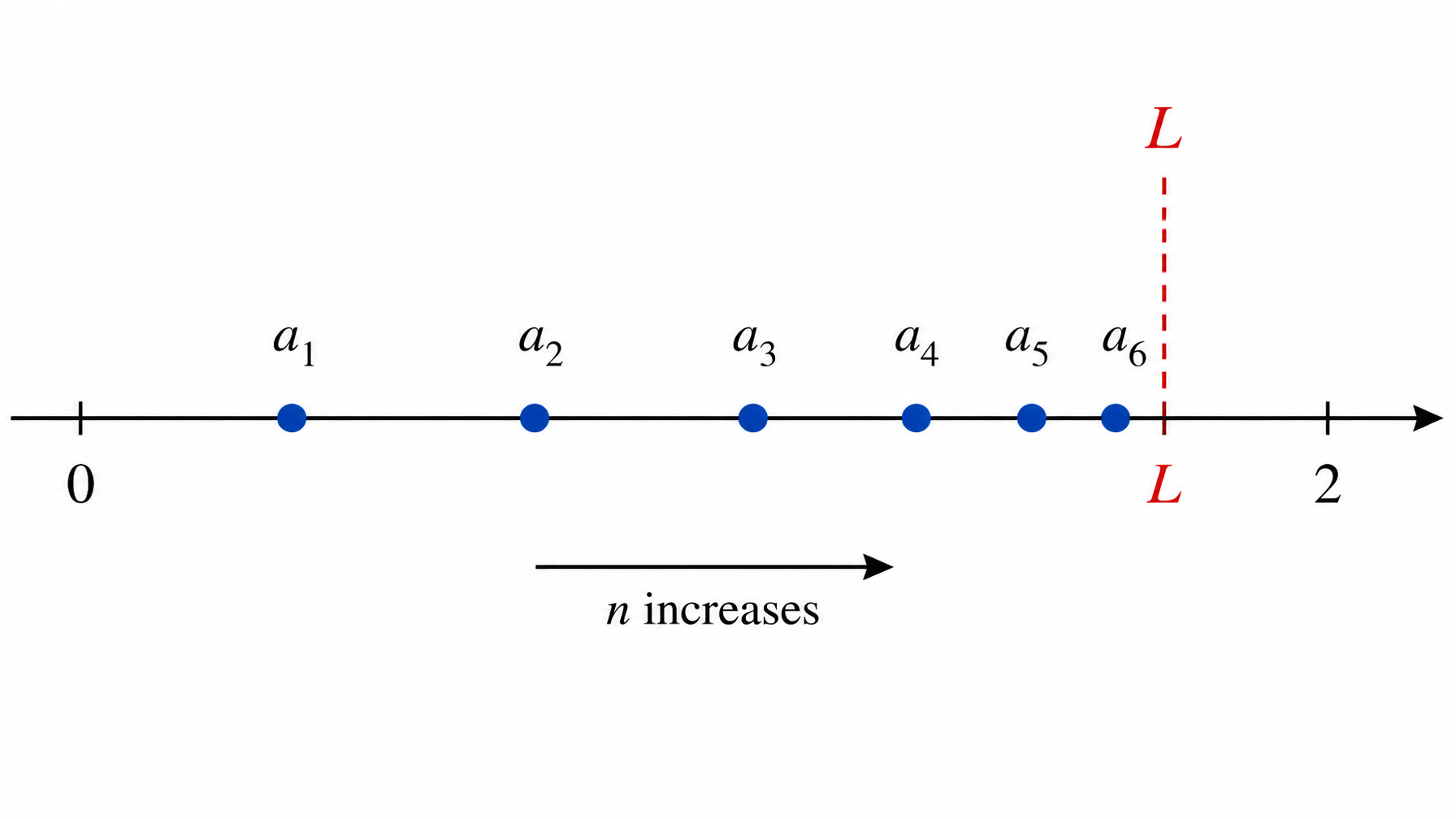
Formal definition (good to recognize, intuition is enough day-to-day):
In plain English: "no matter how small a tolerance you pick, eventually every falls inside an -neighborhood of ."
1.2 Computing Limits — The Four Tools
Tool 1: Direct simplification
Divide top and bottom by the highest power :
Rule: "compare degrees."
- numerator degree > denominator → diverges to
- equal degrees → ratio of leading coefficients
- numerator degree < denominator → converges to 0
Tool 2: Replace by , then L'Hôpital
Treat as a continuous variable: .
⚠️ Trap: L'Hôpital only applies to or . Verify the form first. Most AP problems are written in a form where this is legal.
Tool 3: Squeeze Theorem
When contains , or but is bounded between two known limits.
Example: .
Since :
Both outer bounds approach 0, so .
Tool 4: Memorized limits
| Sequence | Limit |
|---|---|
| or | divergent |
🎵 Audio 4 — Four-tool overview — audio/04_four_tools.mp3
1.3 Monotonic Bounded Theorem (MBT)
Intuition: an elevator that only goes up (monotonically increasing) but is capped by a ceiling (bounded above) must stop at some floor.
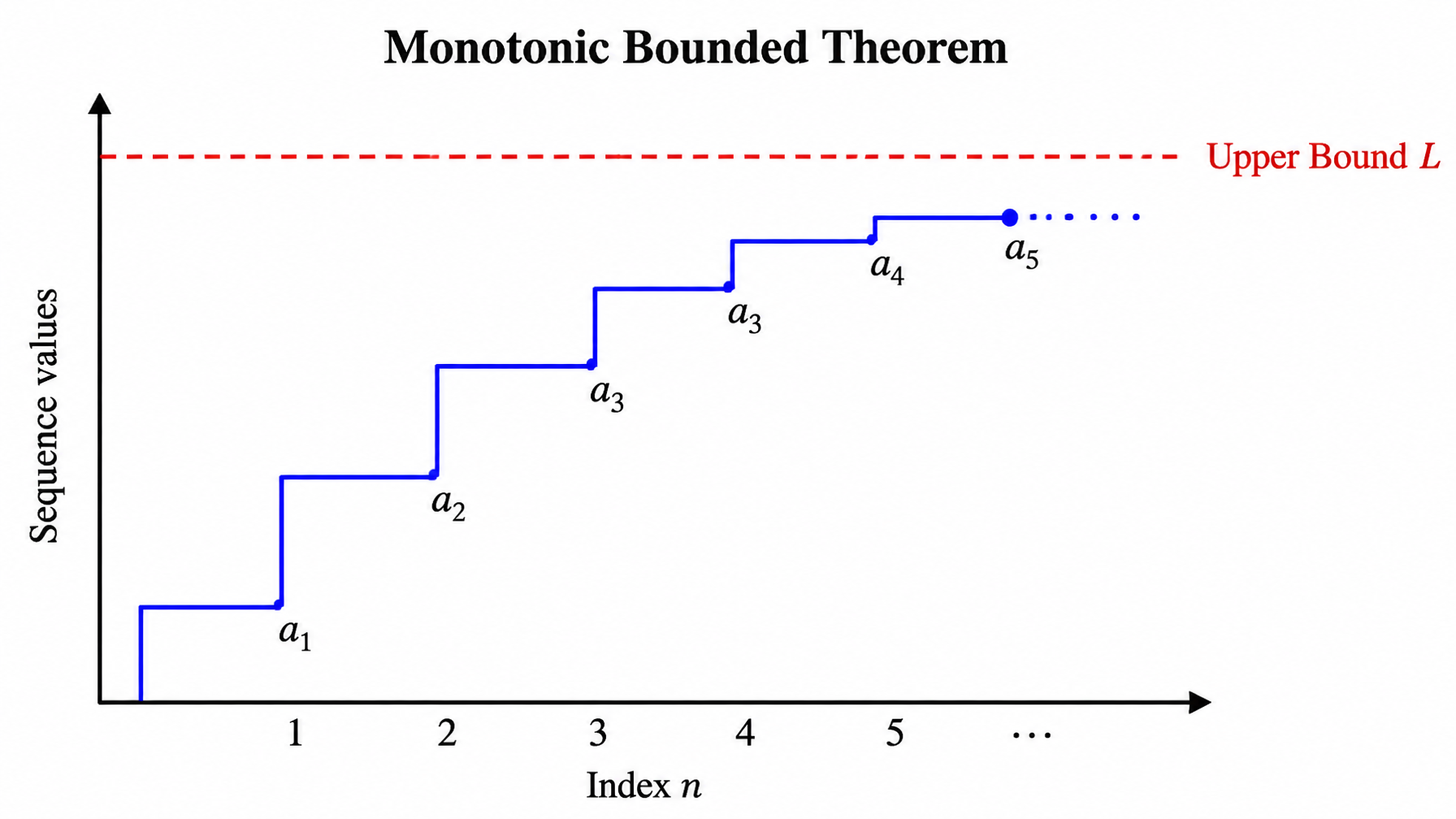
Theorem:
- A sequence that is monotonically increasing AND bounded above converges.
- A sequence that is monotonically decreasing AND bounded below converges.
How to prove monotonicity — three strategies:
- Sign of
- Compare with 1 (when all terms are positive)
- Replace with and check derivative sign
How to find the bound — usually plug in a few terms, guess, then verify by induction.
🎵 Audio 2 — Elevator analogy + solution playbook — audio/02_mbt.mp3
1.4 Worked Examples (Standard → Twist → AP-Level)
Example 1 (standard)
Find .
Solution: divide by :
Converges to 2. ✅
Example 2 (twist)
Decide whether converges.
Intuition: factorial grows faster than any exponential, so this should diverge.
Verify: .
For , the ratio exceeds 1, so keeps growing — diverges to .
🔑 Speed hierarchy (slowest to fastest):
Whichever is in the numerator and slower → limit is 0. In the denominator and slower → limit is .
Example 3 (AP-level — recursive sequence)
Let and . Show converges and find its limit.
Step 1 — Monotonicity? Compute a few terms: . Looks increasing.
Induction: assume . Then , so , i.e. . ✓
Step 2 — Bounded above? Guess upper bound . Induction: . ✓
By MBT, the sequence converges.
Step 3 — Find . Let . Take limits on both sides of the recursion:
Since , . ✅
🔑 AP playbook for recursive sequences: prove MBT → set → solve the equation.
🎵 Audio 5 — Recursive-sequence three-step walkthrough — audio/05_example3.mp3
1.5 Trap Alerts ⚠️
- Sequence convergence ≠ series convergence. but diverges.
- Verify the L'Hôpital form first. Only or qualify.
- alone diverges — it bounces between . But via Squeeze.
- A "candidate" limit is not the limit until existence is proved. In Example 3 you must do MBT first, then solve. Don't skip.
🎵 Audio 6 — Four trap alerts — audio/06_traps.mp3
1.6 Mnemonic
"Compare degrees, remember and , squeeze for noise, MBT for recursion."
- Compare degrees: rational expressions reduce to leading-coefficient ratio
- and : ,
- Squeeze: handles
- MBT: handles recursive definitions
🎵 Audio 3 — Recap + mnemonic — audio/03_recap.mp3
Media Inventory
| File | Purpose |
|---|---|
| audio/01_intro.mp3 | Sequence vs. series intuition |
| audio/02_mbt.mp3 | MBT — elevator analogy + playbook |
| audio/03_recap.mp3 | Chapter recap & mnemonic |
| audio/04_four_tools.mp3 | Four-tool overview |
| audio/05_example3.mp3 | Recursive-sequence walkthrough |
| audio/06_traps.mp3 | Four trap alerts |
| images/01_convergence.png | Number-line convergence visualization |
| images/02_mbt.png | MBT staircase diagram |
End of chapter. Next: series basics, geometric series, and p-series.