Chapter 7 — Common Maclaurin Expansions & Operations
Why this chapter matters : deriving Taylor series from scratch (Chapter 6) is too slow on AP. Most exam problems are solved by memorizing 5 base series and transforming them via substitution, differentiation, and integration. This is the most practical chapter in BC series.
By the end of this chapter you will:
Memorize 5 essential Maclaurin expansions
Use substitution to generate new series (e.g. e x 2 e^{x^2} e x 2 cos ( 2 x ) \cos(2x) cos ( 2 x )
Use term-by-term differentiation/integration to derive related series
Use series tricks to compute sums, limits, and definite integrals
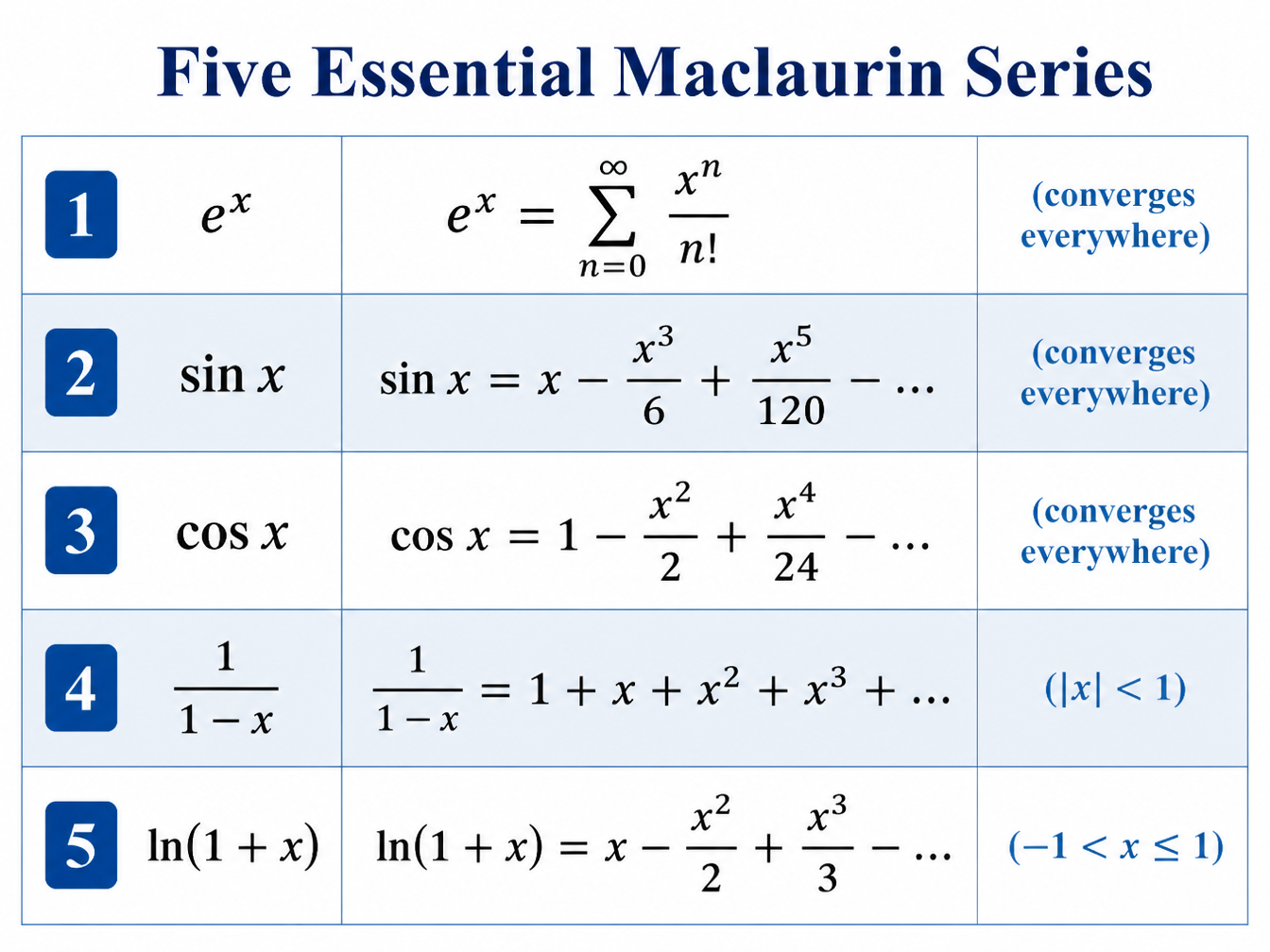
7.1 The 5 Essential Maclaurin Expansions (memorize)
Function
Maclaurin series
Convergence
e x e^x e x ∑ n = 0 ∞ x n n ! = 1 + x + x 2 2 ! + x 3 3 ! + ⋯ \sum_{n=0}^{\infty} \dfrac{x^n}{n!} = 1 + x + \dfrac{x^2}{2!} + \dfrac{x^3}{3!} + \cdots ∑ n = 0 ∞ n ! x n = 1 + x + 2 ! x 2 + 3 ! x 3 + ⋯ all x x x
sin x \sin x sin x ∑ n = 0 ∞ ( − 1 ) n x 2 n + 1 ( 2 n + 1 ) ! = x − x 3 3 ! + x 5 5 ! − ⋯ \sum_{n=0}^{\infty} \dfrac{(-1)^n x^{2n+1}}{(2n+1)!} = x - \dfrac{x^3}{3!} + \dfrac{x^5}{5!} - \cdots ∑ n = 0 ∞ ( 2 n + 1 )! ( − 1 ) n x 2 n + 1 = x − 3 ! x 3 + 5 ! x 5 − ⋯ all x x x
cos x \cos x cos x ∑ n = 0 ∞ ( − 1 ) n x 2 n ( 2 n ) ! = 1 − x 2 2 ! + x 4 4 ! − ⋯ \sum_{n=0}^{\infty} \dfrac{(-1)^n x^{2n}}{(2n)!} = 1 - \dfrac{x^2}{2!} + \dfrac{x^4}{4!} - \cdots ∑ n = 0 ∞ ( 2 n )! ( − 1 ) n x 2 n = 1 − 2 ! x 2 + 4 ! x 4 − ⋯ all x x x
1 1 − x \dfrac{1}{1-x} 1 − x 1 ∑ n = 0 ∞ x n = 1 + x + x 2 + x 3 + ⋯ \sum_{n=0}^{\infty} x^n = 1 + x + x^2 + x^3 + \cdots ∑ n = 0 ∞ x n = 1 + x + x 2 + x 3 + ⋯ ∣ x ∣ < 1 \lvert x\rvert < 1 ∣ x ∣ < 1
ln ( 1 + x ) \ln(1+x) ln ( 1 + x ) ∑ n = 1 ∞ ( − 1 ) n − 1 x n n = x − x 2 2 + x 3 3 − ⋯ \sum_{n=1}^{\infty} \dfrac{(-1)^{n-1} x^n}{n} = x - \dfrac{x^2}{2} + \dfrac{x^3}{3} - \cdots ∑ n = 1 ∞ n ( − 1 ) n − 1 x n = x − 2 x 2 + 3 x 3 − ⋯ − 1 < x ≤ 1 -1 < x \le 1 − 1 < x ≤ 1
🔑 Memorize all five. Multiple-choice speed depends on it.
🎵 Audio 1 — The five must-memorize expansions — audio/ch7_01_basics.mp3
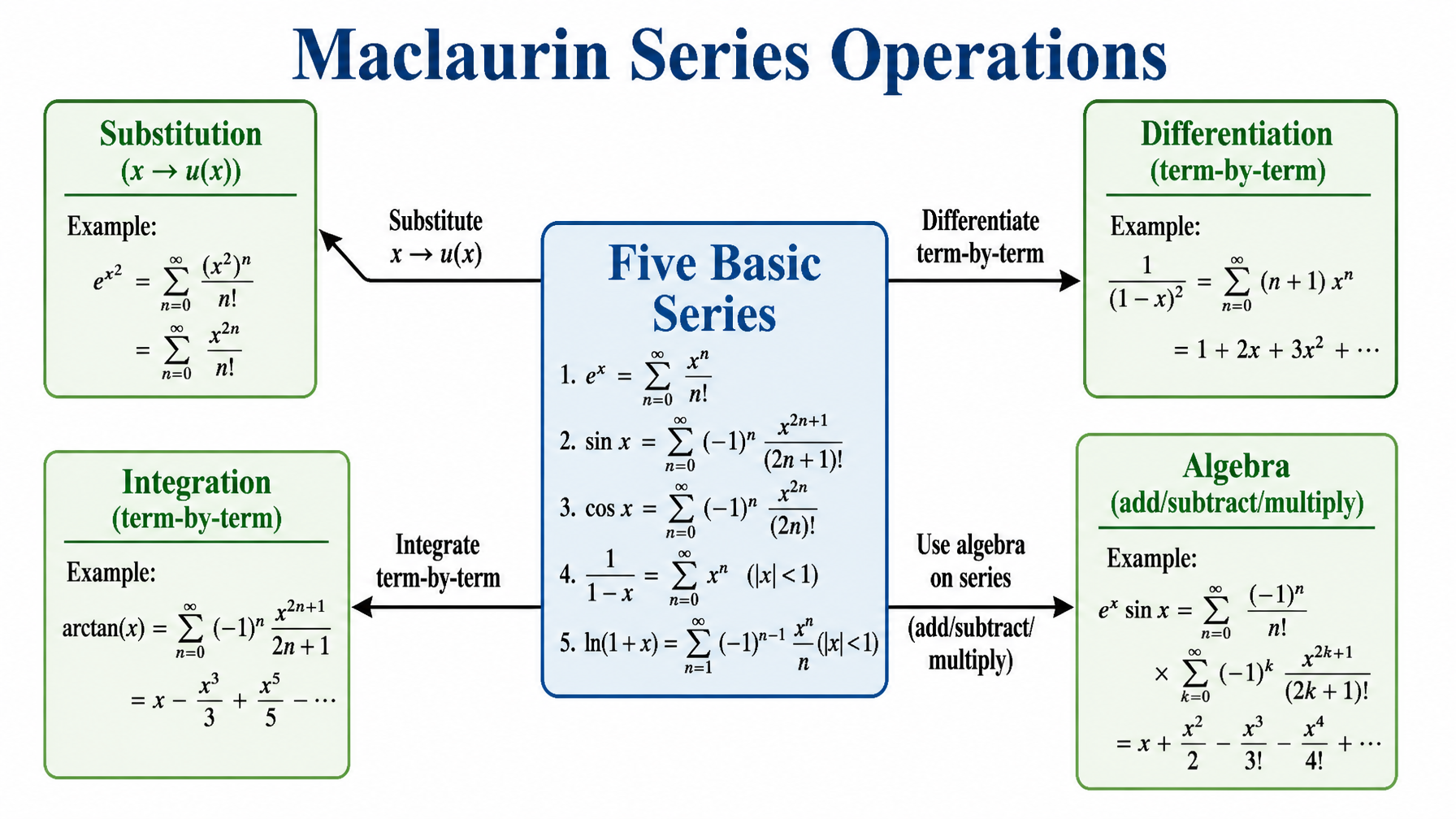
7.2 Operation 1: Substitution
Idea : replace x x x u ( x ) u(x) u ( x ) u u u
Example 1: e x 2 e^{x^2} e x 2
e x = ∑ x n n ! e^x = \sum \frac{x^n}{n!} e x = ∑ n ! x n x → x 2 x \to x^2 x → x 2
e x 2 = ∑ n = 0 ∞ x 2 n n ! = 1 + x 2 + x 4 2 ! + x 6 3 ! + ⋯ e^{x^2} = \sum_{n=0}^{\infty} \frac{x^{2n}}{n!} = 1 + x^2 + \frac{x^4}{2!} + \frac{x^6}{3!} + \cdots e x 2 = n = 0 ∑ ∞ n ! x 2 n = 1 + x 2 + 2 ! x 4 + 3 ! x 6 + ⋯
Radius of convergence: still ∞ \infty ∞
Example 2: cos ( 2 x ) \cos(2x) cos ( 2 x )
Substitute x → 2 x x \to 2x x → 2 x
cos ( 2 x ) = ∑ ( − 1 ) n ( 2 x ) 2 n ( 2 n ) ! = ∑ ( − 1 ) n 4 n x 2 n ( 2 n ) ! \cos(2x) = \sum \frac{(-1)^n (2x)^{2n}}{(2n)!} = \sum \frac{(-1)^n 4^n x^{2n}}{(2n)!} cos ( 2 x ) = ∑ ( 2 n )! ( − 1 ) n ( 2 x ) 2 n = ∑ ( 2 n )! ( − 1 ) n 4 n x 2 n
Example 3: 1 1 + x 2 \frac{1}{1+x^2} 1 + x 2 1
Replace x x x 1 1 − x \frac{1}{1-x} 1 − x 1 − x 2 -x^2 − x 2
1 1 + x 2 = 1 1 − ( − x 2 ) = ∑ ( − x 2 ) n = ∑ ( − 1 ) n x 2 n \frac{1}{1+x^2} = \frac{1}{1-(-x^2)} = \sum (-x^2)^n = \sum (-1)^n x^{2n} 1 + x 2 1 = 1 − ( − x 2 ) 1 = ∑ ( − x 2 ) n = ∑ ( − 1 ) n x 2 n
Convergence: ∣ − x 2 ∣ < 1 ⇒ ∣ x ∣ < 1 \lvert -x^2\rvert < 1 \Rightarrow \lvert x\rvert < 1 ∣ − x 2 ∣ < 1 ⇒ ∣ x ∣ < 1
🎵 Audio 2 — Substitution patterns — audio/ch7_02_substitution.mp3
🔑 Recognition : e f ( x ) e^{f(x)} e f ( x ) e x e^x e x sin ( f ) , cos ( f ) \sin(f), \cos(f) sin ( f ) , cos ( f ) 1 1 + f \frac{1}{1 + f} 1 + f 1 1 1 − x \frac{1}{1-x} 1 − x 1
7.3 Operation 2: Term-by-Term Differentiation / Integration
Key theorem : inside the radius of convergence, a power series can be differentiated and integrated term by term , and the resulting series has the same radius (endpoint behavior may change).
🎵 Audio 3 — Differentiation and integration of series — audio/ch7_03_diff_int.mp3
Example 1: arctan x \arctan x arctan x
d d x arctan x = 1 1 + x 2 \frac{d}{dx}\arctan x = \frac{1}{1+x^2} d x d arctan x = 1 + x 2 1
arctan x = ∫ 0 x 1 1 + t 2 d t = ∫ 0 x ∑ ( − 1 ) n t 2 n d t \arctan x = \int_0^x \frac{1}{1+t^2} dt = \int_0^x \sum (-1)^n t^{2n} dt arctan x = ∫ 0 x 1 + t 2 1 d t = ∫ 0 x ∑ ( − 1 ) n t 2 n d t
Integrate term by term:
arctan x = ∑ n = 0 ∞ ( − 1 ) n x 2 n + 1 2 n + 1 = x − x 3 3 + x 5 5 − ⋯ \arctan x = \sum_{n=0}^{\infty} \frac{(-1)^n x^{2n+1}}{2n+1} = x - \frac{x^3}{3} + \frac{x^5}{5} - \cdots arctan x = n = 0 ∑ ∞ 2 n + 1 ( − 1 ) n x 2 n + 1 = x − 3 x 3 + 5 x 5 − ⋯
Radius 1; both endpoints x = ± 1 x = \pm 1 x = ± 1 [ − 1 , 1 ] [-1, 1] [ − 1 , 1 ]
🔑 Famous result : x = 1 x = 1 x = 1 arctan 1 = π 4 = 1 − 1 3 + 1 5 − ⋯ \arctan 1 = \frac{\pi}{4} = 1 - \frac{1}{3} + \frac{1}{5} - \cdots arctan 1 = 4 π = 1 − 3 1 + 5 1 − ⋯ Leibniz's formula .
Example 2: ln ( 1 + x ) \ln(1+x) ln ( 1 + x )
d d x ln ( 1 + x ) = 1 1 + x = ∑ ( − 1 ) n x n \frac{d}{dx}\ln(1+x) = \frac{1}{1+x} = \sum (-1)^n x^n d x d ln ( 1 + x ) = 1 + x 1 = ∑ ( − 1 ) n x n x → − x x \to -x x → − x 1 1 − x \frac{1}{1-x} 1 − x 1
Integrate: ln ( 1 + x ) = ∑ ( − 1 ) n x n + 1 n + 1 = ∑ n = 1 ∞ ( − 1 ) n − 1 x n n \ln(1+x) = \sum \frac{(-1)^n x^{n+1}}{n+1} = \sum_{n=1}^\infty \frac{(-1)^{n-1} x^n}{n} ln ( 1 + x ) = ∑ n + 1 ( − 1 ) n x n + 1 = ∑ n = 1 ∞ n ( − 1 ) n − 1 x n
Example 3: ∑ n x n − 1 \sum n x^{n-1} ∑ n x n − 1
Differentiate ∑ x n = 1 1 − x \sum x^n = \frac{1}{1-x} ∑ x n = 1 − x 1
∑ n x n − 1 = d d x 1 1 − x = 1 ( 1 − x ) 2 \sum n x^{n-1} = \frac{d}{dx}\frac{1}{1-x} = \frac{1}{(1-x)^2} ∑ n x n − 1 = d x d 1 − x 1 = ( 1 − x ) 2 1
🔑 Strategy : when an "n n n ∑ n x n \sum n x^n ∑ n x n ∑ n 2 x n \sum n^2 x^n ∑ n 2 x n
7.4 Operation 3: Algebraic Operations (Add, Subtract, Multiply)
Add/subtract : combine like-power coefficients.
Multiply : Cauchy product (AP usually wants only the first few terms).
Example: first 4 terms of e x sin x e^x \sin x e x sin x
e x = 1 + x + x 2 2 + x 3 6 + ⋯ e^x = 1 + x + \frac{x^2}{2} + \frac{x^3}{6} + \cdots e x = 1 + x + 2 x 2 + 6 x 3 + ⋯
sin x = x − x 3 6 + ⋯ \sin x = x - \frac{x^3}{6} + \cdots sin x = x − 6 x 3 + ⋯
Multiply term by term:
x 0 x^0 x 0 1 ⋅ 0 = 0 1 \cdot 0 = 0 1 ⋅ 0 = 0 sin \sin sin x 1 x^1 x 1 1 ⋅ x = x 1 \cdot x = x 1 ⋅ x = x x 2 x^2 x 2 x ⋅ x = x 2 x \cdot x = x^2 x ⋅ x = x 2 x 3 x^3 x 3 x 2 2 ⋅ x + 1 ⋅ ( − x 3 6 ) = x 3 2 − x 3 6 = x 3 3 \frac{x^2}{2} \cdot x + 1 \cdot (-\frac{x^3}{6}) = \frac{x^3}{2} - \frac{x^3}{6} = \frac{x^3}{3} 2 x 2 ⋅ x + 1 ⋅ ( − 6 x 3 ) = 2 x 3 − 6 x 3 = 3 x 3
e x sin x ≈ x + x 2 + x 3 3 + ⋯ e^x \sin x \approx x + x^2 + \frac{x^3}{3} + \cdots e x sin x ≈ x + x 2 + 3 x 3 + ⋯
🎵 Audio 4 — Series algebra — audio/ch7_04_algebra.mp3
For a 0 0 \frac{0}{0} 0 0 x = 0 x = 0 x = 0
Example
lim x → 0 sin x − x x 3 \lim_{x\to 0} \frac{\sin x - x}{x^3} x → 0 lim x 3 sin x − x
sin x = x − x 3 6 + O ( x 5 ) \sin x = x - \frac{x^3}{6} + O(x^5) sin x = x − 6 x 3 + O ( x 5 ) = − x 3 6 + O ( x 5 ) = -\frac{x^3}{6} + O(x^5) = − 6 x 3 + O ( x 5 )
lim = lim − x 3 / 6 x 3 = − 1 6 \lim = \lim \frac{-x^3/6}{x^3} = -\frac{1}{6} lim = lim x 3 − x 3 /6 = − 6 1
🎵 Audio 5 — Limits via series — audio/ch7_05_limits.mp3
7.6 Mixed Examples
(a) First 4 nonzero terms of the Maclaurin series for sin ( x 2 ) \sin(x^2) sin ( x 2 )
(b) Series for ∫ 0 1 e − x 2 d x \int_0^1 e^{-x^2} dx ∫ 0 1 e − x 2 d x
(c) Find a closed form for ∑ n = 0 ∞ ( − 1 ) n ( 2 n + 1 ) ! \displaystyle\sum_{n=0}^{\infty} \frac{(-1)^n}{(2n+1)!} n = 0 ∑ ∞ ( 2 n + 1 )! ( − 1 ) n
Solutions :
(a) sin u = u − u 3 6 + u 5 120 − u 7 5040 + ⋯ \sin u = u - \frac{u^3}{6} + \frac{u^5}{120} - \frac{u^7}{5040} + \cdots sin u = u − 6 u 3 + 120 u 5 − 5040 u 7 + ⋯ u = x 2 u = x^2 u = x 2
sin ( x 2 ) = x 2 − x 6 6 + x 10 120 − x 14 5040 \sin(x^2) = x^2 - \frac{x^6}{6} + \frac{x^{10}}{120} - \frac{x^{14}}{5040} sin ( x 2 ) = x 2 − 6 x 6 + 120 x 10 − 5040 x 14
(b) e − x 2 = ∑ ( − x 2 ) n n ! = ∑ ( − 1 ) n x 2 n n ! e^{-x^2} = \sum \frac{(-x^2)^n}{n!} = \sum \frac{(-1)^n x^{2n}}{n!} e − x 2 = ∑ n ! ( − x 2 ) n = ∑ n ! ( − 1 ) n x 2 n
∫ 0 1 e − x 2 d x = ∑ ( − 1 ) n n ! ( 2 n + 1 ) = 1 − 1 3 + 1 2 ! ⋅ 5 − 1 3 ! ⋅ 7 + ⋯ \int_0^1 e^{-x^2} dx = \sum \frac{(-1)^n}{n!(2n+1)} = 1 - \frac{1}{3} + \frac{1}{2!\cdot 5} - \frac{1}{3!\cdot 7} + \cdots ∫ 0 1 e − x 2 d x = ∑ n ! ( 2 n + 1 ) ( − 1 ) n = 1 − 3 1 + 2 ! ⋅ 5 1 − 3 ! ⋅ 7 1 + ⋯
First 3 terms: 1 − 1 3 + 1 10 = 23 30 ≈ 0.767 1 - \frac{1}{3} + \frac{1}{10} = \frac{23}{30} \approx 0.767 1 − 3 1 + 10 1 = 30 23 ≈ 0.767 ≈ 0.7468 \approx 0.7468 ≈ 0.7468
(c) Compare with sin x = ∑ ( − 1 ) n x 2 n + 1 ( 2 n + 1 ) ! \sin x = \sum \frac{(-1)^n x^{2n+1}}{(2n+1)!} sin x = ∑ ( 2 n + 1 )! ( − 1 ) n x 2 n + 1 x = 1 x = 1 x = 1 sin 1 = ∑ ( − 1 ) n ( 2 n + 1 ) ! \sin 1 = \sum \frac{(-1)^n}{(2n+1)!} sin 1 = ∑ ( 2 n + 1 )! ( − 1 ) n
🎵 Audio 6 — Walkthrough of (a)–(c) — audio/ch7_06_examples.mp3
7.7 Trap Alerts ⚠️
Substitution changes the convergence interval. 1 1 − x \frac{1}{1-x} 1 − x 1 ∣ x ∣ < 1 \lvert x\rvert<1 ∣ x ∣ < 1 1 1 − 2 x \frac{1}{1-2x} 1 − 2 x 1 ∣ x ∣ < 1 2 \lvert x\rvert<\frac{1}{2} ∣ x ∣ < 2 1 Term-by-term differentiation/integration only inside the radius. Endpoints can change.Don't lose the constant of integration. When recovering f f f f ′ f' f ′ f ( 0 ) f(0) f ( 0 ) Recognize the right template . 1 1 + x 2 \frac{1}{1+x^2} 1 + x 2 1 not a ln \ln ln 1 1 − ( − x 2 ) \frac{1}{1-(-x^2)} 1 − ( − x 2 ) 1 Multiplication: stop at the requested degree. Higher-order terms are wasted work.
🎵 Audio 7 — Traps + recap — audio/ch7_07_traps_recap.mp3
7.8 Mnemonic
"Five base series + four operations."
Five base: e x , sin , cos , 1 1 − x , ln ( 1 + x ) e^x, \sin, \cos, \frac{1}{1-x}, \ln(1+x) e x , sin , cos , 1 − x 1 , ln ( 1 + x )
Substitute: x → u ( x ) x \to u(x) x → u ( x )
Differentiate: when a series has an "n n n 1 1 − x \frac{1}{1-x} 1 − x 1
Integrate: arctan \arctan arctan 1 1 + x 2 \frac{1}{1+x^2} 1 + x 2 1
End of chapter. Next: Lagrange error bound.