Chapter 8 — Lagrange Error Bound
Why this chapter matters: this is the most challenging topic in BC series — but every problem follows the same template. Memorize the formula and the 3-step method, and you'll handle any AP error problem.
By the end of this chapter you will:
- State the Lagrange error bound formula
- Compute an upper bound on the truncation error of a Taylor polynomial
- Use the error bound to prove a Taylor series equals the original
- Solve "how many terms?" inverse problems on the AP
8.1 Why Lagrange?
Recall Chapter 6: the Taylor polynomial approximates . The natural question is: how big is the error?
Lagrange gives both an exact formula (with one unknown ) and a practical upper bound.
🎵 Audio 1 — Why we need this — audio/ch8_01_motivation.mp3
8.2 The Lagrange Remainder Formula
Taylor's theorem (with remainder): if is -times differentiable on an interval containing and , then
where the remainder is
for some between and (existence guaranteed; exact location unknown).
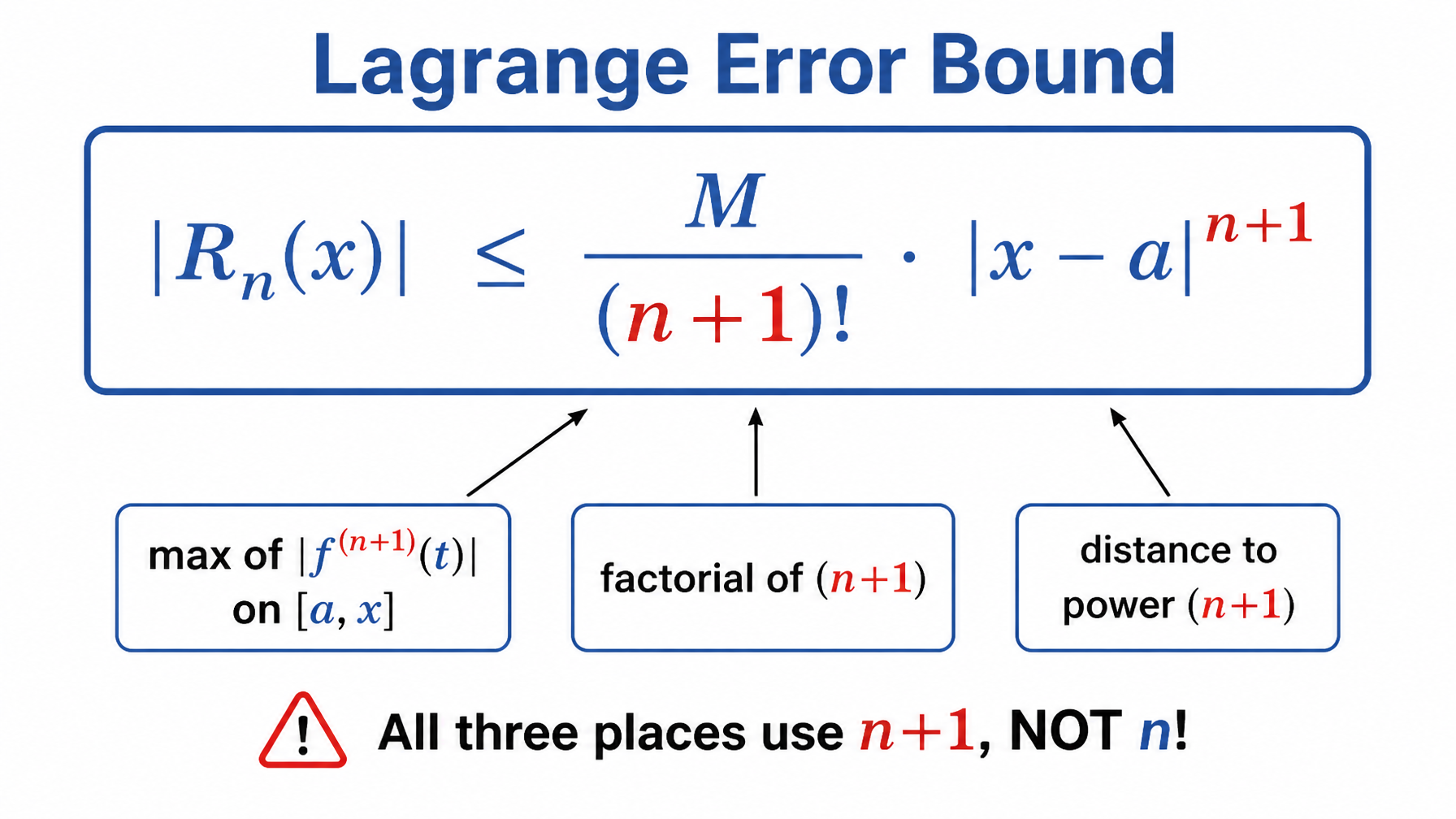
Lagrange error bound (the practical form):
where is an upper bound for on the interval between and .
🎵 Audio 2 — Formula breakdown — audio/ch8_02_formula.mp3
🔑 Three things to remember:
- bounds the -th derivative — not the -th
- All three slots use (factorial, derivative order, distance power) — easy to off-by-one
- The closer is to , the smaller the error
8.3 The 3-Step Method
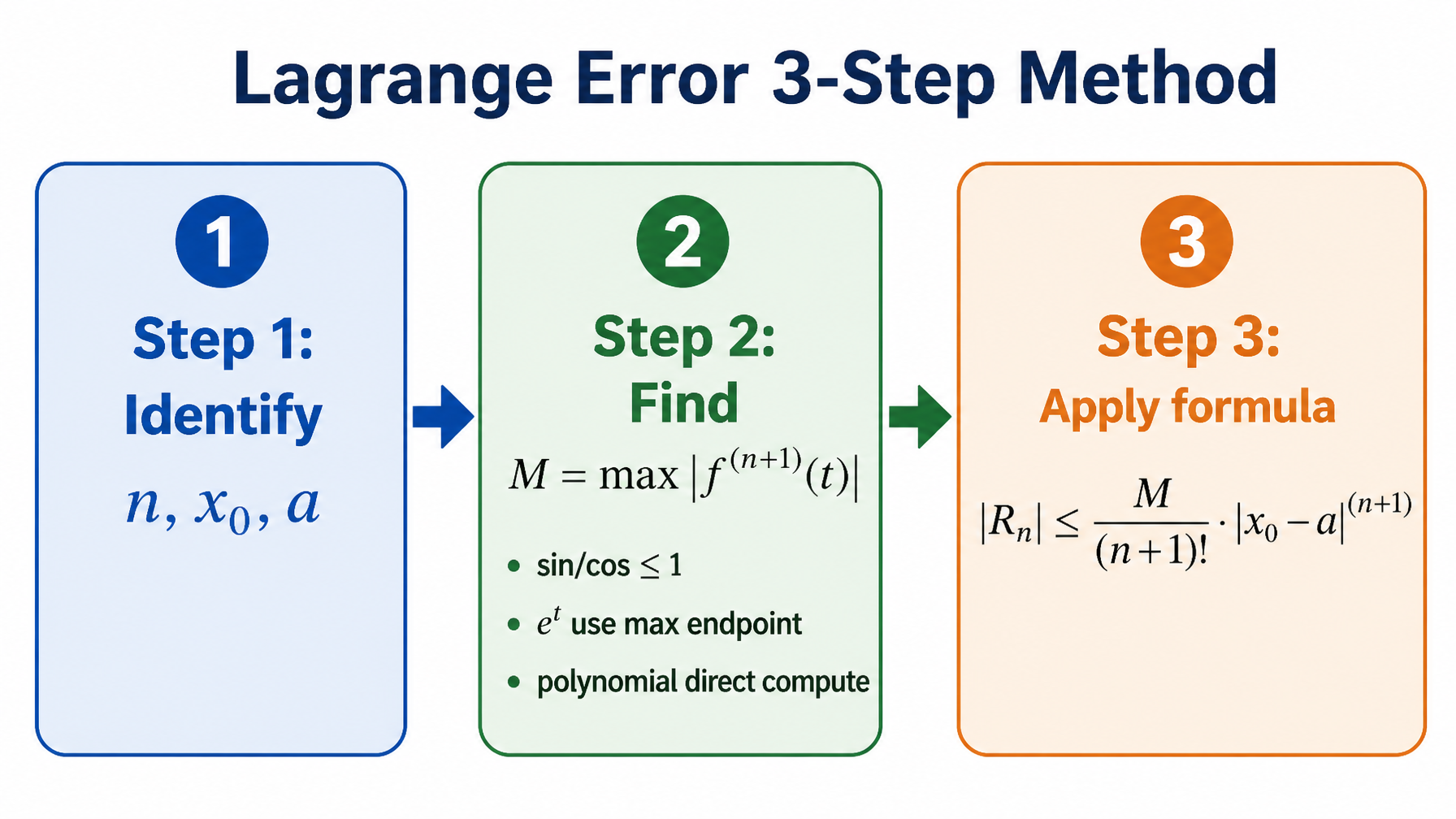
Step 1: identify , ,
The problem will say something like "use the degree- Taylor polynomial to estimate "; that gives you , , .
Step 2: find — the key step
Find an upper bound for on the interval (or ).
Practical shortcuts (memorize):
| Bound on | |
|---|---|
| on | |
| polynomial | direct computation |
Step 3: plug into the formula
🎵 Audio 3 — 3-step method — audio/ch8_03_three_steps.mp3
8.4 Example 1 — Estimate
Problem: use the degree-5 Maclaurin polynomial of to estimate . Bound the error.
Step 1: , , .
Step 2: , so .
Step 3:
Estimate: .
True , actual error — well within the bound. ✓
🎵 Audio 4 — sin(0.5) walkthrough — audio/ch8_04_sin_example.mp3
8.5 Example 2 — Inverse Problem (AP-favorite)
Problem: estimate using the Maclaurin polynomial of . What's the smallest degree that guarantees error below ?
Approach: find smallest with .
Step 1: . Take .
Step 2: solve by trial:
- : ✓
- : ✗
Smallest degree: .
🎵 Audio 5 — Inverse / smallest-degree problem — audio/ch8_05_precision_search.mp3
🔑 Strategy: increment from small values until the inequality holds. Don't try to solve inequalities algebraically.
8.6 Proving a Taylor Series Equals
Theorem: if for every in an interval , then the Taylor series equals on :
Example: prove for all .
Fix . on or .
since for any fixed .
So the Taylor series converges to for every real . ✅
🎵 Audio 6 — Proving Taylor convergence to — audio/ch8_06_convergence_proof.mp3
8.7 Comparing AST and Lagrange
| AST error bound | Lagrange error bound | |
|---|---|---|
| Applies to | alternating series satisfying AST | any Taylor polynomial |
| Formula | ||
| Cost | one term lookup | derivative bound + power |
| Scope | alternating only | universal but more work |
🔑 Choosing: if the series alternates, AST is faster. Otherwise use Lagrange.
8.8 Mixed Example (AP-style)
Problem: , , . Bound .
Step 1: , .
Step 2: , so .
Step 3:
Estimate vs true , agreement to . ✓
🎵 Audio 7 — Mixed example + recap — audio/ch8_07_examples_recap.mp3
8.9 Trap Alerts ⚠️
- Off-by-one on . The formula uses , , and — all three.
- bounds the -th derivative, not the -th.
- is over only, not the entire real line.
- derivatives all bounded by 1 — easiest case. requires .
- AP free response wants you to show how was found — don't skip the justification.
8.10 Mnemonic
" in the denominator, caps the next derivative, distance to the -th power."
All three slots use .
Media Inventory
| File | Purpose |
|---|---|
| audio/ch8_01_motivation.mp3 | Why Lagrange? |
| audio/ch8_02_formula.mp3 | Formula breakdown |
| audio/ch8_03_three_steps.mp3 | 3-step method |
| audio/ch8_04_sin_example.mp3 | sin(0.5) walkthrough |
| audio/ch8_05_precision_search.mp3 | Inverse problem |
| audio/ch8_06_convergence_proof.mp3 | Proving Taylor = |
| audio/ch8_07_examples_recap.mp3 | Mixed example + recap |
| images/ch8_formula.png | Formula card |
| images/ch8_three_steps.png | 3-step flowchart |
End of chapter. End of the BC series deep-dive notes.